Tuesday, September 8, 2015
Album Review: Quor - Human Paradigm
I'm starting to think that maybe I'm too hard on the 'mainstream rock' scene. While there is still the disgusting success of bands like Five Finger Death Punch that make me weep, there is actually some hope out there. This year has seen a very solid album from the new 'supergroup' Saint Asonia make a decent impact, and now Ghost has managed a top ten album. That alone tells me that the mainstream of rock doesn't have to pander to the lowest common denominator in order to succeed. While the scene isn't going to revert back to the old days, the ones I remember, where bands didn't have to have a sense of absurd macho roid-rage in order to be taken seriously, but there is some hope.
QUOR is introducing themselves with this, a debut album that collects tracks from their earlier EP. Having missed out on that, this is also my first exposure to the band. What do they have to offer?
"The Silence And The Spark" starts us off with a big, heavy riff played with a guitar tone that heaps on plenty of distortion. They're definitely going for something huge, although I often think that the opposite is how to actually make guitars sound beefier. The song reminds me of a song from Metallica's "Load", but played with the production of their 80s records. The vocal tone alternates between screaming and a Hetfield-esque shouted singing. The riffs are ok, and the chorus tries to be melodic, but the hook isn't polished enough to really stand out.
"When The Gods Speak" changes things up in the vocal department, as the bouncy riff segues into a verse that sounds like it could have come off a Volbeat album. And if you know what I'm saying, that's not exactly a good thing, since it's inexplicable how Volbeat is able to get away with it. The chorus, though, is solid, which really glues the whole thing together. It's a bit odd, but it's a pretty good song.
Through the rest of the tracks here, we get much of the same. The riffing is the standard modern rock tropes, and the vocals add a hint of strain to cleaner tones. The problem with all of these songs is that they simply aren't sharp enough. There's nothing egregiously bad about them, but there is also little that's memorable. There's a reason why modern rock gets called faceless, and it's because the chugging guitars never play anything that can be easily recalled by a listener. That's the case here, since while the songs are fine to listen to, I can't recall a riff from the record. That might be ok if the melodies were strong enough, but like a lot of bands finding their way, they need to be more finely honed before they turn these songs into killing machines.
A lot of young bands fall into this category, and Quor is no different. There are signs of optimism on this record, but it's a raw, embryonic document of who Quor are. Experience will help them develop their songwriting and their identity, but for now, "Human Paradigm" is merely a rough sketch of the future.
Sunday, September 6, 2015
Album Review: Amorphis - Under The Red Cloud
I've never gotten much into the scene that gets described as either 'dark metal' or 'melancholy metal', which is actually funny, because when I do hear some of these bands, they are often playing some of the most beautifully melodic metal of anyone out there. Something about the deeper side of emotions resonates in a melodic way that is highly appealing, as long as the underlying feelings don't begin to seep inside you and work their influence. I suppose that's why I've been hesitant to review more albums that fit the bill; I actively try to avoid music that I know is going to make me feel lousy. It doesn't work that way for everyone, and I've had arguments about this before, but depressing music isn't usually good for me. But when I hear the beauty a band like Katatonia can conjure, I'm willing to give it a chance.
Amorphis is one of the bands that fits this bill, turning out highly emotional metal that preys on the darker side of our emotions. But instead of turning that into bitter hate and ugly black metal, they remind us that there's something beautiful in all of the human conditions. Their music is not what you would call hopeful, but it is reassuring in the sense that the darkness is normal.
The album opens with the title track, softly introducing itself with a piano figure before the guitars come in with their ringing metallic crunch. There's guitar harmonies over the top of chugging riffs, while the chorus digs deep with growled vocals roaring over the maelstrom. Those death metal roots shine through in the tremolo-picked riff of "The Four Wise Ones". The song is much more interesting than that, with heavy folk influences that pop up and give the song a tantalizing flavor.
But it's on track three, "Bad Blood", that everything kicks into gear. That track is the perfect blend of heavy death metal through the verses, and soaring hooks in the chorus. Maybe you could say it sticks a little too close to the formula, but that exists for a reason. It's an absolutely killer track.
When Amorphis focuses on their hooks, the songs are uniformly great. "The Skull" and "Death Of A King" are similarly effective, and then "Sacrifice" strips away all the death metal elements for a dark pop sound that is startling in how engaging it is. Like latter-day Katatonia, it shows the beauty that comes from misery.
This might not be my style of music, but I don't need to be a fan to know quality when I hear it. My mood isn't often right for this kind of music, but when it is, "Under The Red Cloud" is a remarkably good example of how to do it right. I can't claim to have been familiar with Amorphis beyond their name before this, but they've made an album here that is the best thing I've heard all year with any death metal roots. Take my praise with the requisite grain of salt, since I'm not the usual audience, but "Under The Red Cloud" is great stuff.
Saturday, September 5, 2015
Album Review: Soilwork - "The Ride Majestic"
A review should never be about the reviewer, but permit me this minor indulgence just this once, as so much of my experience with Soilwork’s music is tied into my personal listening experience with their career to this point. This is the only lens through which I can judge “The Ride Majestic.”
My relationship with Soilwork, long a favorite band of mine, seems to be in flux. It comes upon a recently reflection that my three personal favorite Soilwork records, “Natural Born Chaos,” “Figure Number Five” (a personal all-time top ten record,) and “Stabbing the Drama” tend to be the three albums that many Soilwork devotees enjoy the least. Nevertheless, as Soilwork rolls on with more records that are named with increasingly abstract titles, what keeps me attracted to the band is that there has always been a small handful of organically transcendent singles that either float the entire album (“Two Lives Worth of Reckoning”) or unlock the rest of the experience (“The Living Infinite I”.) A certain amount of filler and experimentation has always been anticipated on a Soilwork record, because the band likes to channel their energies into a variety of artistic styles.
“The Ride Majestic,” by contrast, lacks those solidly rhythmic singles that have always insured that each Soilwork record remains firmly anchored to terra firma. In their place, the band trades in an increase in multi-faceted metal, bordering on technical metal and accompanied by a wide range of new and different sounds from Soilwork.
And what a menagerie of looks we get from the Swedish veterans. Perhaps most interesting is the sound of “Petrichor by Sulphur” which features an entire bridge sounding like a cut from A Pale Horse Named Death. This is actually the most interesting part of the record, because it sounds so far afield from the normal expectations of Soilwork. Juxtaposed by the slow but insistent melodic constructions on either end, this track ends up as the album’s crown jewel.
With that said, the album also experiments with the band’s more melodic side, incorporating some much more open and lighter fare for “The Phantom” and “Death in General” while also reverting to a more classic version of their idiomatic sound for many other spots on the record.
What colors most of these songs generally in that they have no one color. Selecting “All Along Echoing Paths” as just one example, we see from beginning to end the technical side, thrash side and melodic side of Soilwork. Other times there’s borderline black metal, atmospheric metal and a hundred other shades ranging from black to gray on the metal spectrum.
What stands as most interesting about “The Ride Majestic” from the standpoint of a longtime listener is that drummer Dirk Verbeuren, so long a metal craftsman who possesses intimate understanding of how to create atmosphere with his drums, seems content to reduce himself to metronomic percussion, rather than creating a feeling or setting a tone. Yes, his beats for “The Ride Majestic” on expectedly on-point but come across as somewhat cold and antiseptic, disconnected at worst.
So, there’s something for every Soilwork fan, unless of course, you happen to be me, and the elements you always preferred to see the band utilize are conspicuously absent. In a twist, fans going all the way back to “Steelbath Suicide” or “Chainheart Machine” may be lured back into the band’s good graces by their sonic assault.
Wednesday, September 2, 2015
Album Review: Iron Maiden - "The Book of Souls"
Chris C: I have been one of the most staunch defenders of Iron Maiden's reunion era. While plenty of fans were disappointed with the slower tempos and progressive bent, I was more than happy to hear the band not resting on their laurels, and fully embracing who they were at their ages. We've seen bands like Metallica and Judas Priest try to recreate their past, and it is almost always met with a sense of what once was. Iron Maiden has, by their choice, been making some of the most vital music of their career, producing four albums that, to me, are their 'classic era'.
"The Book Of Souls" is the most challenging album yet, a double record that showcases every facet of the band's modern sound. Throughout the ninety-two minute running time, we get some of the biggest epics the band has ever written, plenty of traditionally Iron Maiden heavy metal, and a few new twists and turns along the way. Aside from the curiosity that accompanied each change in singer, this is easily the most interesting Iron Maiden album to walk into.
I was concerned about the record being so long, as any sort of music is difficult to take for that long without it becoming stale. "The Book Of Souls" tries its darndest to be diverse enough to justify its length, and for the most part is succeeds. I still would have preferred a seventy-five minute single album, but there isn't anything on this record that I can easily write off as filler. That, by itself, is commendable.
There is plenty about this album that is easy to love. The Bruce Dickinson penned "If Eternity Should Fail" gets things off to a ripping start. Sounding like a cross between Iron Maiden's typical sound and his recent solo albums, it's a dark and heavy number that finds Bruce in fine form, with one of those melodies that only he can seem to come up with. The other songs he had a hand in, "Speed Of Light" and "Death Or Glory" are easily among the catchiest on the record. Janick Gers contributes two excellent tracks as well, as both the title track and "Shadows Of The Valley" use Eastern motifs that blend beautifully with the melodies given to Bruce. They're what you would expect from this incarnation of Iron Maiden, but that's not a problem. Great songs are great songs.
Then there's the oddity that is "Tears Of A Clown", which is one of the most straight-forward rock and roll songs I can remember the band writing. It almost sounds out of place on a record like this, but its low-key delivery works really well, and it's a nice diversion from the weightier pieces here.
But I have to say that, even though I am a flag-waving supporter of modern Iron Maiden, there is also a fair bit about "The Book Of Souls" that I'm not as fond of. Steve Harris' epic, "The Red And The Black", never sounds as vital to me as "Where The Wild Wind Blows" off of the previous record. In fact, several of the tracks with Harris' name on the writing credits lack bite, and don't have the strongest vocal lines for Bruce to sing. That makes a song like "When The River Runs Deep" come across a bit flat.
For me, though, the biggest problem lies in the decision to twice, in the epics "The Red And The Black" and Dickinson's "Empire Of The Clouds", stretch out the instrumental sections for upwards of five minutes. I understand they have three guitarists to cycle through, and the band is well-regarded for their solos and harmonies, but those breaks are too long to keep my attention. Particularly annoying is the break in "Empire Of The Clouds", because as a story that is trying to tell a story, the guitars don't move the narrative along at all. The song on either side is clearly something Bruce poured his heart into, but it just doesn't come together as well as I would have liked it to.
Overall, "The Book Of Souls" is an album I'm having a hard time coming to a conclusion on. They've finally found the perfect balance of studio sheen and live rawness in the production, and there's at least an hour of very good Iron Maiden material here, but there's also nothing that matches the highlights from the previous records. This album doesn't have a "Ghost Of The Navigator", a "Pachendale", an "Isle Of Avalon". So while it's still a rock solid and very good Iron Maiden album, I can't quite say it's a great one.
D.M: Let me be upfront here - "Book of Souls" is, I'm pretty sure, my favorite Maiden record since "Brave New World." Now that's a lower bar for them to clear for me than it is for you, as I have not in general been a huge fan of the albums since the reunion. Although, a sidebar, if you'll allow - Iron Maiden, more than many bands, has songs that are just simply better live than in studio. "Fear of the Dark" is the obvious choice that jumps to mind, but "Hallowed Be Thy Name," while great on the album, is secretly one of the great live songs of all time. I tell you that story to tell you this one; I struggled to get a lot of value out of "The Final Frontier" on my home stereo, but the songs from that album, particularly "Coming Home" make for an immersive and powerful live performance. So these albums have value on a sliding scale.
That said, I really enjoy the craftsmanship of "Book of Souls," and I daresay that maybe Maiden has gotten hold of something by sourcing the writing out to different members. This album doesn't feel as unfocused as many of the recent records have, and there remains a good bit of Maiden's trademark gallop that's preserved throughout the experience "Death or Glory" and "Shadows of the Valley" to cite two examples.
Let's have a quick chat about that, shall we? It occurs to me that many Maiden fans have dropped off over the years or reduced their fandom over the notion that these recent works don't have the same energy or get up and go as the classics of the past, and maybe that's true. But for one, I agree with you that it's small-minded to think that so intelligent and skilled a band would be content to create the same product over and over, and I also get that it's pedantic to think that Dickinson would have the same vitriol and rebelliousness in his voice that he did in 1982 - moreover, maybe he does have that, and simply chooses to do something different, what of that possibility?! Getting back to it in reference to "Book of Souls" however, there are plenty of moments on this record that would have fit perfectly well on the b-side of "Powerslave" or "Piece of Mind." Is there an "Aces High?" No, not really, but then that album only has one "Aces High," doesn't it?
Here's where the reviewing gets a little dicier though. I'm tempted to, but it's too easy an out to simply say that the album is too long. An album is, after all, a sum of its parts, and so if you have a collection of very long songs, then the album will be long. So, to me, the issue is that some of the songs are too goddamn long.
I'm actually a little surprised that you and I are generally in such close agreement on these points, because historically we tend to have divergent views unless talking about the general overrated-ness of Behemoth. This is why, in the what, five years we've been working together, we've named but one consensus album of the year (Graveyard's "Lights Out" for those playing our home game,) and even that wasn't number one on my personal list that year. (I had it second to The Admiral Sir Cloudesley Shovell's "Don't Hear It...Fear It!" A decision which I stand by for the time I made it, but might not make again three years later.) Anyway, forgive me my rambling - the point of all that was that we both hit upon the same stumbling block, which is "The Red and the Black." I actually like the song on principle. It's got a nice rhythm, a defined harmony of guitar and a memorable chorus that moves along at a good clip...for about six minutes. Why on God's green earth is this song thirteen minutes long?
Ultimately, that's my main issue with sections of "Book of Souls," is that the songs are good, but many of them don't fit their own length. "If Eternity Should Fail," which is a genuinely good song, is about the only cut on the album that can testify convincingly about why it's over six minutes long, while many of the other lengthy pieces could have easily shed a minute or two or six. They feel, dare I say, long for long's sake, which can be a real problem. It doesn't detract wholly from the album, but it does make for some eye-rolling, head-hanging and yes, yawning, as you wait for some of these epics to conclude. "Book of Souls" for this reason, is better thought of, and better ingested, as individual singles. Otherwise, it gets exhausting.
Where you and I differ is that I actually really like "Where the River Runs Deep," because I feel like it's a song that is perfectly sized for its content and appropriately constructed to be worthy of high praise. It immediately feels like one of 'those' Maiden tunes, the ones that we'll all be in full throat for, singing along with Bruce at some jam-packed arena show in the not too distant future. As a general commentary of the whole album, I appreciate Maiden's attempts to do some different things, like bending away from their typically upright and crisp guitar tone for the solos of "Tears of a Clown," and the very idea that Maiden looked at "Speed of Light" and said 'well damn it, we've never written a cock-rock song before, let's give it a shot!' Those are some of the album's most brilliant moments, capturing off-the-cuff ideas from talented musicians and refining them into something greater.
You know me; I tend to be automatically suspicious of any record where I feel there's a strong possibility that fans and critics will gush over it simply because of the name on the front of the album jacket. I still feel that way about "Matter of Life and Death," and Black Sabbath's recent "13," and probably always will. I loathe the very principle that people can say 'well, it's Band X, Y or Z, so it'll be great because they can do no wrong!" or worse yet "it's great because they were great twenty years ago!" In this case though, I think the praise of "Book of Souls" is well-earned, as the album is enjoyably creative from start to end. Just be prepared to press 'next track' when these monsters start to get long in the tooth.
Still a question nags me, one that I hate to even address for fear of sounding like a recalcitrant - is it possible that Iron Maiden has composed these long pieces, this ninety-plus minute epic, in some small measure because of arrogance? Not arrogance that the fans will take what the band gives them and like it, but rather an arrogance in the vein of 'we are Iron Maiden, and we can do whatever we want?'
Chris C: We have certainly held different opinions of the most recent Iron Maiden albums, but I'll be honest here, my own opinion on them has been shifting as well. The more that I listen to them, and the more that I've been exploring some new sounds, I my rankings of them have changed. For as long as we've known each other, "Dance Of Death" has been my favorite of their albums. While I do still love that record, my own experiences as a songwriter have made it a bit harder to enjoy these records than it used to be. What had been dubbed 'repetitive chorus syndrome' never bothered me much in the beginning, but now I find it very hard to listen to songs like "Blood Brothers" and "Dance Of Death" without wondering how a writer could allow that to happen. The one record that has been aging the best for me is "The Final Frontier", which tapped into the same bent of progressive music that I was in at the time. It still has flaws, and does drag on, but it may have taken up the mantle of my favorite.
Maiden fans are like fans of most bands; they say they don't want more of the same, but they really do. There is a very limited window of evolution that fans are willing to accept, before the band has veered too far from their identity. Maiden was never just the three minutes of speed band that their reputation became, but at a certain point the slower tempos and longer songs got to be too much for a lot of the fans, which is silly, because who expects a band of guys in their 40s to be playing torrid metal like that? Doing so would have felt even more fake than trying something new that perhaps didn't work.
We do have very different perspectives, which is one of the things I love about these projects of ours. It shows that great heavy music can appeal to all manner of people. And while we may have only converged on one Album Of The Year, hindsight has shown me that if my hears knew then what they know now, we could have also agreed on Graveyard's previous album.
But you are right about some of the songs being too long for their own good. One such song would be ok on an album; an indulgence of art. But when there are two and three, it becomes tiresome, even for someone who listens to a fair amount of prog. I actually think it's less of a problem here than it was on "A Matter Of Life And Death", as we get more 'shorter' songs this time out. The massive length of the double album makes it seem worse than it is.
Here's my armchair psychology: I don't consider Maiden's recent work to have much to do with arrogance, but with mortality. Let me explain. Steve Harris has always had an appreciation for progressive rock, and Bruce Dickinson for classical art (he did, after all, make a solo album based on the art and poetry of William Blake). When the band reformed, and they didn't know how long they had left as an entity, they decided to prove that they were more than just a heavy metal band. I attribute this era to a desire to be remembered for more than "The Trooper", to be real artists and not just a group of guys who played fast music. To me, these five albums made more sense that way, as there's a real through-line of thought that connects them, and explains why they don't go back and give people the short, speedy album they claim to want.
That's something I respect Maiden for. They have absolutely decided to make the music they want to make, and they consider their recent work to be just as vital as their early stuff. That can't be said about most bands of their age, who make records merely as excuses to go back out on tour. "The Book Of Souls" might not be my favorite Maiden album, but it's something you absolutely have to respect.
So let me finish by asking a question; if Iron Maiden had debuted with these records in the 80s, would anyone be complaining?
D.M: Okay, we're agreeing entirely too much for my own comfort here. This is weird. Human sacrifice, dogs and cats, living together, mass hysteria! Let me create a little separation just for comfort: I like "The Book of Souls" a lot, it's a pretty damn fine record, and we're really picking at nits here overall. That said - it's no "Number of the Beast." Yes yes, I admit, I am one of those Maiden fans. Which dovetails nicely into --
I don't know if anyone would have complained about these albums if this were the first thing we had ever heard from Iron Maiden (after all, what reference would they have had to complain about,) but I do think these records might have been more easily passed over.
Take a look at the contemporary market of the first five Maiden records - so, 1980-'84. The metal scene is very much in flux for this stretch - Black Sabbath was transitioning into the Dio years and the fan base was divided on that count (still is. Plus, they were coming off the last two Ozzy records, which were, well, shitty.) Cirith Ungol was active, but couldn't get a foothold; their reputation was as that band your weird uncle listens to that sings about elves and isn't Jethro Tull. Motorhead was pretty firmly established by 1980, but never considered themselves a 'metal' band. Venom would release both "Welcome to Hell" and "Black Metal," and I enjoy those albums as much as the next guy, but I think we can all agree they're not up to the same standard as those Maiden records and mainstream sales numbers evaded them for a long time. The Big 4 (and the other American thrashers) wouldn't debut until 1983, and wouldn't conquer the world for another two to three years at least. Even the lofty veterans Judas Priest, who dropped "Screaming for Vengeance" in '82, are plagued with inconsistency in this era (any defenders of "Point of Entry?" Anyone?) and are also still more a rock band at this point.
In the meantime, England's progressive scene was choked full - By this time, Yes, ELO, Asia and King Crimson are all active and firmly embedded in their careers. Prog was no longer new or novel, and the popularity of those bands likely overtook the combined popularity of the bands in the previous paragraph.
So, see, a big piece of what made "Number of the Beast" work so well was its timing. The audience was starved for a band who could deliver an album that combined punk's merciless, no-nonsense attitude with metal's speed and fantastic, visceral imagery. "Iron Maiden" and "Killers" both make their mark, but it's the addition of Bruce Dickinson's literary intelligence and ability to set the stage that truly broke the dam open for metal in the modern sense. By the end of 1982, the band is selling out Madison Square Garden on the strength of that album alone. "Number of the Beast" sets the stage for all the metal that follows and also sets the typecast for metal as a whole, with its threatening undertones, mature themes and 'demonic' subject matter.
Circling around, my point is that I think if Maiden releases "The Final Frontier" or "Matter of Life and Death" or even a goodly chunk of "Brave New World" (sans "The Wicker Man") in that same time period, they would have been just another cog in the long-form prog wheel, or at best, a rich man's Cirith Ungol. Now yes, they may have been the king of that world, but they still would have been confined to that world. These are not the albums that audience would have snapped up, at that specific time.
Whew. I think that's my final thought. In closing, yeah, "The Book of Souls" is a long but overall listenable record, with a lot of highlights that are worth hearing. Probably second in line behind only "Brave New World" of the post-reunion records.
Chris C: I probably should have been clearer. My hypothetical wasn't intended to be a game of "what if" for the entire world of music. I was concerned more with merely the level of criticism Iron Maiden receives from the old-guard fans for not following the blueprint of those days (which really wasn't a blueprint - they still released a fourteen minute prog epic, introduced keyboards, and made a concept album). It's nothing but a guess on my part, but I'm of the opinion that the criticism would not exist at nearly the same level had Iron Maiden been more brazen about these influences at the time. They were always there, but were lurking more under the surface, which rose-colored glasses have made people look past.
Not to get off-topic, but since you brought it up, let me say one thing about the Dio years of Black Sabbath. Whether you love those records or not (I am in the former group - "Heaven & Hell is, to me, the greatest metal album ever made), Ronnie James Dio allowed Black Sabbath to become something more than they were with Ozzy. They were trying to become more than what they had been pigeon-holed as, and it was when Dio gave them melodic freedom that they were able to show their true musical skill. That's not to say Iommi and Butler weren't coming up with great riffs before, but much of the admiration that they get as musicians, and not just as metal players, comes from those two records they made in that first run with Dio.
To finish off with the topic at hand, I actually agree with you that "The Book Of Souls" is a very good record. There are certainly highlights here that are worth seeking out, even if the album as a whole overstays its welcome a bit. At an hour and a half, I don't think any album would be able to stand up to nit-picking. "The Book Of Souls" is on its own a very good album, but when you compare it to the late-career double album made by that other British metal mainstay, it's a damn miracle.
Tuesday, September 1, 2015
Video Premiere: Tad Morose - "Black Fire Rising"
Swedish
metal veterans Tad Morose have released a lyric video for their new
single, Black Fire Rising." The third single from their newly released
'St. Demonius' album (you can read our review here), "Black Fire Rising" is described by singer Ronny
Hemlin as "a nightmare so vivid in which death was so imminent and real
that if dreamt again it will most certainly lead to death for real."
"Black Fire Rising" iTunes link - https://itunes.apple.com/us/album/black-fire-rising-single/id1027916542
'St. Demonius' iTunes link - https://itunes.apple.com/us/album/st.-demonius/id989572441
We here at Bloody Good Music are honored to premiere the band's new lyric video for the track "Black Fire Rising". Check it out at this YouTube link, or embedded below.
St. Demonius is out worldwide now, on Despotz Records.
The band will support the album's release with a European tour kicking off on 3 September in Copenhagen, Denmark and concluding on 13 September in Vasby, Sweden. The dates are as follows:
4 Sept Wuppertal, Germany - Underground
5 Sept Eernegem, Belgium - B52 Club
6 Sept Weert, Netherlands - De Bosuil
7 Sept Verviers, Belgium - Spirit of 66
8 Sept Erfurt, Germany - Club From Hell
9 Sept Bielsko-Biala, Poland - Rudeboy
10 Sept Prague, Czechoslavakia - Nova Chmelnice
11 Sept Szczecin, Poland - Kosmos
12 Sept Hamburg, Germany - Live Music Club St Pauli
13 Sept Malmo, Sweden - Dr. Feelgood's
Monday, August 31, 2015
Album Review: Riverside - Love, Fear And The Time Machine
Over the course of their career, Riverside has staked a claim as one of the most important bands in the modern prog scene. They receive rapturous reviews, push their own boundaries, and I've even heard it said that they've been on the best run in the world of prog since the glory days of Rush. Myself, I'm not willing to go quite that far. They are a band I enjoy, but one that has often failed to deliver on the promise they embody. While I quite like "Anno Domini High Definition", it is the only record in their discography that has any energy to it, any sort of rock edge. Mostly, they border so often on the softest material possible, that they become a white noise machine.
This time out, Riverside abandons the gimmick of making album names that are acronyms, but not much else has changed. This is still the same Riverside you know and (maybe) love, with their atmospheric take on prog, and heavy doses of emotional vocals.
"Lost (Why Should I Be Frightened By A Hat)" opens the album in a way that epitomizes what Riverside is all about. A single plaintive guitar winds through a simple riff for several minutes while the vocals tell a somber tale, with some gorgeous harmonies laid over the top. There's a hint of an electronic beat underneath a few moments, before the song finally segues into a full band arrangement. Even then, the energy is decidedly laid-back, and the band is more focused on making something beautiful than rocking out. I'm not sure it's the most engaging way to open a record, but the melodies are beautiful, and pure Riverside.
Even when the band turns up the volume, which they do on the following "Under The Pillow", their harder-edge sound is still soft and soothing. The focus shifts a bit here, with more emphasis put on the guitars, which introduce a dark, descending riff, and then segue into a beautiful, extended solo. Combined with the hints of organ that pop out of the background, Riverside is excellent at setting a tone with their music. There's a very specific vibe that they evoke, one that comes out in every one of their records, but I sometimes wonder if it is the reason I struggle to relate to their music.
Riverside's music is beautiful, but it is also somber. There's a string of melancholy that runs through everything they do, and as someone who tries to use music to life myself up, that sense of sadness does make the music harder to enjoy. While it's expertly crafted, it explores an emotional range I seldom want to investigate in my listening. It's difficult to feel good while listening to Riverside, no matter how good they are at making the music they do.
Take for instance the opening minutes of "Saturate Me", which play with time signatures through a riff that ebbs and flows, with a flurry of muted notes that don't appear at first glance to fit a pattern. It's a wonderful bit of music, because you hear something interesting if you're paying close attention, and something entirely different, but equally worthwhile, if you are listening to the surface level. But from there, the song turns back into a typical Riverside track, and all of the buildup seems to have been for naught.
The best track here is easily "Discard Your Fear", the first single, which is the only song that has any sense of urgency to it. The usual Riverside trademarks are here, but the song moves just a touch faster, and that makes all the difference. Instead of sounding like a soundtrack for a rainy day, the song has a hint of bounce to it, and the melody is able to hook me. It's a gorgeous song, and only makes me wish the band could have explored this road a bit more often.
I'm not saying this is a bad record, but it's not one for me. People who love music that mirrors their darker feelings will absolutely love this. It's a beautiful record, and certainly a well written one, but it isn't what I want out of music. That's not a criticism of Riverside, or of myself. We are the proverbial ships passing in the night. They do what they do, I want what I want, and though we probably won't be able to come together, I can still respect them and their music.
Sunday, August 30, 2015
Album Review: Pentagram - "Curious Volume"
Pentagram stands as one of the all-time heavyweights in American metal. Working now in their fifth doom-laden decade, the band has not only been the continual standard bearer for American doom, but frontman Bobby Liebling has been idolized and celebrated more than most singers in the genre as a whole. In all of metal’s menacing history, perhaps only Diamondhead stands ahead of Pentagram for the title of band that has influenced the most musicians while still having mainstream acceptance elude them. Nevertheless, what’s old is new again, particularly in the digital age when history is easy to research, and Pentagram continues to thrive as they approach the age when most normal mortals would contemplate retirement and the rocking chair.
Whenever a band with as much experience as Pentagram releases new material, there is always the threat that it’s simply a cash-in, that the gears turn only just enough to cough out another excuse to shell out fifteen bucks for the album and more to have people come see the walking museum that the live show has become. Rest easy fans, Pentagram is giving you a genuine effort on their new album “Curious Volume.” If there is a silver lining in having widespread fame elude a band for forty years, it’s that the band remains hungry and Liebling and company still approach their music with wild eyes and calculated misery, rolling their ravenous appetite for metal into an effort that contains riffs of authentic malice and rumbling thunder.
There is an amusing scene in the Christopher Guest vehicle “A Mighty Wind” where The Folksmen’s bassist Mark Shubb (Principal Skinner, for “Simpsons” fans) quips “To do then now would be retro. To do then then was very now-tro, if you will.” That’s sort of the feel of Pentagram’s latest work, as the band provides us with a resurgent take on yesterday’s emergent sound, cut and packaged in an era where very few bands seem to recall the lessons of yesteryear.
Skipping to the end first, the slow churn of “The Devil’s Playground” bristles with magnificence, one of those great tunes that strikes the proper balance between foreboding storm clouds and head-nodding listenability (which isn’t a word, but whatever.) These are the hallmarks of the genre – the ability to be infectious while at the same time narrating a dire story of trial and tribulation.
Not to be outdone, the vast bulk of the album is cut from the same cloth, as the sparse but churning riff of “Lay Down and Die” crackles with analog hum, standing in contrast to the burst of percussion beneath. It is in these moments when Pentagram proves their mettle, channeling the experience of a long career into true, atmosphere-altering songcraft.
One of the base touchstones of doom has always been the ability to transition into different strengths and musical bridges, giving the listener a wide arsenal of sounds to enjoy, each section debuting just when it seems the previous cadence might run out of gas. Here, too, we see Pentagram succeed where so many show their inexperience; the pummeling of “Walk Alone” shifts into a different gear for the outro, moving from a slogging dirge to a springy and memorable second life.
It is difficult to find fault with “Curious Volume” except to have the obligatory conversation that this album is ‘old skool.’ If listeners prefer their doom solely in morose, downtrodden tones, with mumbled, growling lyrics and at a rate of one note per ten seconds, well, tough luck. Nor will fans looking for the deepest thematic depravity find much satiation, as the album never stoops to out and out visceral descriptions of surgery performed without consent or some other purely corporeal dreck. Rather, this is an album composed out of the boiling cauldron of the genre’s auspicious beginnings, far more apt to examine the inner turmoil of an unquiet mind. The lowest common denominator has little place here.
What Pentagram really proves by the slowly boiling conclusion of “Curious Volume” is that doom is not now, nor has it ever been, simply a matter of selecting three blues minor chords and playing slow. The music must have character and color and tone and this new record broods with slumbering anger and the kind of intellectual understanding of doom that genre fans demand. “Curious Volume” is a great record, Pentagram’s best effort in years and a worthy addition to anybody who thinks metal was at its best when Black Sabbath and Cirith Ungol and, well, Pentagram ruled the roost.
Album Review: Jasmine Cain - White Noise
As a critic, it's easy to get hyped up for the next major release from one of the big-name bands that you know you have to write about. The PR machine swings into gear early, and there's no way to avoid hearing every little detail up until the release. The problem is that, while the music can be great, you know that the corporate till is thick enough that those artists will never see your words, and even if they do, they will fly out of their heads without a second thought. That's why the most rewarding experiences I've had as a writer involve independent artists, where a relationship can form where we have mutual respect for one another. Finding a great independent record is always one of the highlights of my year.
Jasmine Cain comes to us as one of those independent artists, a singer and songwriter bringing us an album of heavily melodic rock that fills a very important void in my ears. But we'll get to that specific comment later.
The album opens with "Coming In Hot", where you can immediately hear the thick guitars as they play a simple but easy to latch onto riff, and Jasmine's vocals come in with a killer tone. Her voice is a touch deeper, with just a hint of roughness around the edges. It's perfect for giving the music a rock edge, even when the songs are more polished. It's a catchy little opener, but I'll admit that it might be my least favorite song on the record. That's not because it isn't good, but rather because the rest of the album kicks it up into another gear.
The title track is an aggressive cut, with a ton of energy carrying through the bouncing chorus. The emphasis of the composition puts the focus on Jasmine, which is a smart decision, both because she delivers on the melody, and because her voice is the standout feature of the sound. Great singers should never play second-fiddle to a band, and Jasmine is out front and center dominating this album.
With those two tracks out of the way, we hit the stretch of the album that I absolutely love. Starting with "Break Even", the songs tone down the rock aggression just a bit, and bring the melodies to the fore. That makes them a touch more inviting, but more than anything, it gives Jasmine more room for her melodies to stick. All these songs have big, catchy hooks that remind me of growing up listening to the radio in the mid and late 90s, when big guitars and big hooks were the formula for success. She remembers this too, as evident by the song "1995", which pines for those exact days.
The album closes with "Fall To Rise", which features a guest vocal from Steel Panther's Michael Starr. This is the best song he's ever sung, and the first time I'm convinced of his talent. Without the sophomoric comedy to hide behind, he has to use his voice, and the grit in both his and Jasmine's voice give poignancy to the track, and bolster the emotional heft. It's a great song, and a masterful use of getting the most out of a guest star. But as great as that is, my favorite song on the album is "Fool's Gold", which has a massive, massive hook that is nearly impossible to ignore.
And that brings us to my initial observation. "White Noise" is a really good album that bridges hard rock and pop, but it's even better when you factor in how well it fills the hole for exactly that kind of music that Halestorm left this year. There are similarities between Jasmine and Lzzy's voices, and "White Noise" feels like a record that could easily sit next to former Album Of The Year "The Strange Case Of..." in a discography. Jasmine has made a record I was waiting to hear this year, and it definitely hits the spot. If you like pop-laced hard rock, "White Noise" will be music to your ears.
Wednesday, August 26, 2015
Album Review: Motörhead - Bad Magic
Some bands have the negative reputation of making the same album over and over again. When you think about it, however, it's a remarkably stupid criticism to have. If a band has their own style, and they're good at what they do, why should they change everything about who they are and do something completely different? That kind of radical change may sound 'artistic', but it also is a recipe for disaster, if it isn't something the band themselves desperately want to do. And then there's the fact that there are some bands that are so identifiable by a sound that you wouldn't want them to be anything else. Seriously, who wants Motörhead to be anything but Motörhead ?
Now on album number twenty-two, Motörhead are still playing the same music they were back when they formed. Over the years, little has changed, and honestly, that's for the best. Motörhead is not one of those bands that needs to tackle new territory. They are a pure, dirty rock and roll band, and that never goes out of style.
"Bad Magic" continues the run that the Lemmy/Phil Campbell/Mikkey Dee lineup has been on, establishing them as the best (although not the classic) roster the band has ever had. Since they've been together, they haven't had a misstep, and have occasionally made records that are as vital as "Ace Of Spades", even though they can never get that level of acclaim.
This time out, Motörhead is hitting short and sweet, heavy and hard, with only one of the twelve original tracks exceeding three and a half minutes by more than five seconds. Whereas some of the modern Motörhead records have tried to be heavier, or tried to branch out a bit, "Bad Magic" is raw rock and roll with little concern for anything but coming in with a riff and a chorus. It's a catchier record than the previous one, which may owe much to the fact that Lemmy sounds recovered from his health issues, his vocals stronger, although double-tracked in places.
The opening run of "Victory Or Die", "Thunder & Lightning" and "Fire Storm Hotel" are pure Motörhead , with bluesy swagger, a hint of boogie, and manic rock and roll energy. They're all catchy tracks, and well worth a Motörhead fan's time. It may be only my opinion, but I feel like Lemmy has gotten better at crafting his melodies as he has aged, which gives recent Motörhead records a better anchor for the songs to swing around.
"The Devil" is a song that should be a live favorite, with low-hanging guitars and a chorus that starts and stops in perfect head-banging time. If old Motörhead was all about speed, this is what new Motörhead is all about. And frankly speaking, I like this a whole lot more.
There is the curious case of "Evil Eye", a song I can't figure out. Instead of the usual Motörhead chorus, there's a section where Lemmy's vocal is an echoed growl placed oddly in the mix. It doesn't sound right, and the lyric gets garbled under the effect. It's easily the worst song here. But that is more than made up for by the album's curve-ball, the ballad "Till The End". This song finds the band playing an almost power ballad, with Lemmy stripping the grit from his voice as he sings about mortality. The chorus swells with beautiful aplomb, and it's hard not to think that this is what "Bad Magic" is going to be remembered for. It's one of the best Motörhead tracks in ages.
Going into a Motörhead album, you know what you're going to get. That's both the good thing and the bad thing about it. What you hope for is that the band is going to deliver a set of songs that play to their better tendencies. "Bad Magic" definitely does that. I can't say where it belongs in the hierarchy of their career, but I say it's a better album than their previous one, and it's another example of what Motörhead does best.
Tuesday, August 25, 2015
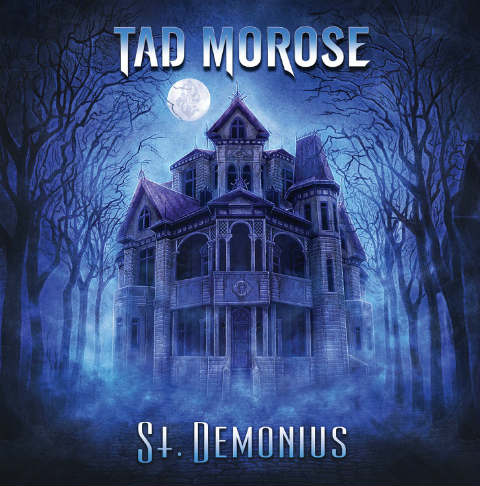
Album Review: Tad Morose - St Demonius
It's been a long time since Tad Morose was a name that meant anything in the world of traditional and power metal. For years, they were building a name as an intriguing force that was moving the sound in a heavier direction. Their album "Matters Of The Dark" is still a favorite of mine, and "Modus Vivendi" is the album that most people consider their crowning achievement. They had everything going for them, but then the band began to crumble. It took them eight years to replace Urban breed and put out a new record, and when they finally did, it was a shadow of what they used to be. What I heard from that album was utterly forgettable, and didn't give me any hope for the resurrection of the band.
Now back for their second album in this incarnation, Tad Morose needs to make a statement that they were just finding their sea legs on the previous album, and that they haven't forgotten how to make good music. That can be a tall order when it's been so long, so are they able to do it?
"Bow To The Reaper's Blade" opens the album off solidly, with a thrashy riff that leads into a chorus that slows the song down, but emphasizes the heaviness. I'm not one of those people who thinks everything needs to be complicated to be good, but I can see where some will say the riffing is too simplistic. The 80s synth line is a nice touch, but I'm not sure the tempo shifting is well-integrated enough for the song to quite hold together. The parts are there, but maybe not the whole.
"Forlorn", which follows, is a better track. Everything fits together well, and the subtle backing vocals in the chorus make a huge difference. It stands out and sounds huge, which only helps to emphasize the hook. It's meat and potatoes songwriting, but that's where this version of the band is best suited, and the decision to not try to expand into more progressive territory is smart. Listening to these songs, and specifically the way the riffs and melodies are constructed, I think anything more adventurous would have exposed the band as not being ready.
As the record moves forward, we get a string of songs that all follow the band's blueprint; heavy, chugging riffs that lead into simple choruses. When they do it well, the songs are quite enjoyable. The downside is that, because of how the songs are written, much of the immediate appeal is placed solely on the vocals, and that's the one area the band isn't quite consistent enough. Ronny Hemlin has a tone that I don't particularly enjoy, where he sounds like he's oversinging quite often, and his writing isn't hooky enough to match what I expect of Tad Morose. There are a few choruses where his melodies sweep appropriately, like in "Darkness Prevail", but when you hit songs like "Black Fire", I couldn't even tell where the chorus was.
What I can say about Tad Morose is that all these years later, and despite the lineup shifts they've been through, they haven't forgotten what the band sounds like. They may not be quite as adventurous or energetic as they once were, but there's no mistaking this for anything but a Tad Morose record. There's something to those riffs that reeks of Tad Morose, and from that perspective this is a success.
Like the previous album, my conclusion when listening to "St Demonius" is that Tad Morose is missing the key ingredient to making a comeback to where they once were. I'm not saying that is necessarily Urban breed, since he has been involved in projects that fell short as well. But "St Demonius" is lacking the huge melodies and massive hooks that the best Tad Morose material used to have. Putting this on right after "Matters Of The Dark" is like night and day. It's clearly the same band, and the guitars are riffing as well as they used to, but the songs themselves don't make the same impact. "St Demonius" isn't a bad record, but it is one where you can obviously hear the band still trying to find their way.
Subscribe to:
Posts (Atom)