Sunday, May 17, 2015

Remembering Dio - Five Years Later

Our lives are filled with watershed moments, but we don't always recognize them as they are happening.  Events unfold, and only later, when the details are fuzzy, do we realize that we have experienced something truly remarkable.  It's a sad fact of life, one that does us no favors as time marches on, and our memories begin to fail us.  The most important moments of our lives can be lost to us, forgotten gems that get buried under the sands of time.

I don't remember the first time I heard Ronnie James Dio's monumental voice, though I'm sure it must have come when Pop Up Video played "Rainbow In The Dark".  Even then, when I was too young to know better, I realized that the song was unbearably cheesy, and yet it still managed to stick with me.  Even though I would not remember the moment clearly, I would remember what I heard.

Sadly, Ronnie James Dio is not able to make new memories for us.  It has now been five years since we lost the greatest singer in the history of heavy metal, which is as good a time as any to take a step back and remember what Dio has meant not just to ourselves, but to the very fiber of the music we love.  Without Dio, there's no telling where metal would be, where we would be as fans, and we would have been robbed of one of the greatest careers in all of recorded music.

Ronnie James Dio remains a vital part of metal for two reasons; 1) He is perhaps the greatest voice metal has ever produced, and 2) He is the focal point of the greatest run of albums in the history of heavy music.

The first point can be debated, because voices are so subjective that there is no way to quantify one as being better than another.  Tones hit our ears in such unusual ways that a singer's voice is almost like pulling a suit of the rack; it may fit well enough, but it's the luck of the draw to find one that is perfect.

The second point, however, I would claim as being as close to a fact as you can have in a subjective forum.  From Rainbow's debut album, all the way through to the first four albums with his eponymous band, Dio barely moved the gauge off of perfection.  People can point to Metallica's first four records (a topic I will address at some point), or Iron Maiden's 80s output, but for my money, Ronnie James Dio had the greatest run, with the greatest albums, that metal will ever see.

The reason for this is that Ronnie James Dio had the ability, as sports fans would say, the ability to play to his competitor's level.  When he was matched with Ritchie Blackmore at the height of his powers, or a Tony Iommi with everything to prove, Dio was untouchable.  It was only when he was paired with a guitarist who lacked the fire or the skill that he stepped down from the top of the mountain.

****

Ronnie James Dio's career started long before he met Ritchie Blackmore, but that was the genesis of the Dio we know.  Dio met Blackmore while his band Elf opened for Deep Purple, and after the fracture that led to Blackmore leaving Deep Purple, Dio was recruited as the singer for Blackmore's new band, Rainbow.  In the course of three albums, Dio and Blackmore elevated hard rock to a new place, they may have written the greatest hard rock song of all time, and Dio began the greatest run in the history of heavy music.

Ritchie Blackmore was always eccentric, and without the rest of Deep Purple to reign him in, there was no telling what his new band would sound like.  Coupled with a singer most of the world was hearing for the first time, Rainbow's first album was met with a fair amount of skepticism.  The record was not great, but it showed a band with enormous potential.  Dio was one of the few singers who could match the power of Blackmore's guitar, and on songs like "Man On The Silver Mountain", the combination was impossible to deny.  Blackmore's later retreat into the world of Renaissance music is now apparent on that record, which comes through on "Temple Of The King", a song that showed Dio was more than a giant voice.
   
The potential for greatness existed in that record, and was fully revealed on "Rising".  In the short span of time separating the records, Rainbow had blossomed into one of the greatest hard rock bands of all time.  "Rising" was a short record, one that wore you out in the span of half an hour.  Though concise, everything about "Rising" was epic in scope.  Blackmore's playing became more fiery, Dio's voice bigger, the hooks stronger, and the songs became larger than life.  By the time "A Light In The Black" fades out, and the silence of an empty room returns, Rainbow has taken you on a journey to placed music had never gone.
   
"Stargazer" is often called one of the greatest rock songs ever written, and for good reason.  Everything about the song goes over the top, but in a way that makes excess feel like a good thing.  The band was at their absolute peak at that moment, and Dio's vocal was as towering and impassioned as any that came before or since.  His vocal performance is a staggering work, and remains his defining moment.  The song was something special, and "Rising" was the first in a string of classic albums Dio would be a part of.
   
Rainbow's final album with Dio could not match "Rising" in terms of elevating hard rock to a new level.  What the album was able to do, however, was show that Rainbow could operate on all levels of rock music, this time turning out a set of songs that was more focused on Dio's vocals than before.  His melodies carry songs like "Lady Of The Lake" and "L.A. Connection", and his soulful delivery made "Rainbow Eyes".  The only drawback to the record was "Gates Of Babylon", an amazing epic in its own right, but one that drew comparisons because of its similarity to the legendary "Stargazer".  Rainbow was done innovating, which made the splintering of Dio and Blackmore easier to handle.  They had done all they could together, and the time was right for them to move on to new projects.
   
For Dio, that project was Black Sabbath.  No one could have known at the time that the marriage of Dio and Black Sabbath would work.  Nothing about what either of them had accomplished to that point indicated they would work well together.  Dio had yet to make a metal record, and Sabbath's style had been typified by Ozzy singing Tony Iommi's riffs, a status Dio would surely not continue.
   
"Heaven & Hell" was a monumental record for everyone involved.  If it failed, there was no telling where their careers would go.  Black Sabbath would have been all but dead, and Dio would have been looking for his third band in three albums, granting him journeyman status.  They might not have known it at the time, but they were making the album that would come to define the rest of their lives.
   
"Heaven & Hell" was more than just an album that showed Black Sabbath was still alive, it was an album that ushered in an entire new era of heavy metal.  Just as their first four albums created metal as we know it, "Heaven & Hell" created the metal that came to define the 80s.  Each side changed the other, Dio giving Iommi the freedom to write more than simple block riffs, and Iommi giving Dio the platform to unleash his imagination.  Together, they rebuilt what was expected of heavy metal at the time.  Instead of being slow, lumbering music that was full of gloom, Black Sabbath had shown a new light, one in which heavy metal could be musical, could be positive, and could escape the stereotypes it had become chained to.
   
For the first time, metal had a band that was still heavy, but was playing melodic music that took as much influence from rock as it did Black Sabbath themselves.  By reinventing who they were, Black Sabbath reinvented the entirety of metal.  Dio's melodic edge, along with his fantasy-inspired lyrics, opened up a whole new world that would soon be populated by the success of the New Wave Of British Heavy Metal, along with the hair and glam bands on the Sunset Strip.  Countless bands would call "Heaven & Hell" one of their greatest inspirations, a fitting tribute to perhaps the greatest heavy metal album ever made.
   
"The Mob Rules" followed, and as was the case with Rainbow, the next album was rooted in growth.  Though it was not far removed from the sound of "Heaven & Hell", "The Mob Rules" expanded the compositions, juxtaposing moods and textures to a greater degree.  "The Sign Of The Southern Cross" had not yet been contemplated as they made their first record together, but now it was at the very core of who this version of Black Sabbath was.  They were the light and dark, the yin and yang of metal.  The album proved they were a band that could do anything they wanted, but greatness always comes at a cost, and for Black Sabbath it meant moving on to yet another new singer.
   
Having been a part of four classic albums in a row, Dio's next venture was likely to fail.  The odds of making yet another classic album were against him, but Dio proved his legend.  With an unheralded new guitarist in tow, Dio's first album under his own name became the landmark of his career.  "Holy Diver" was not just an album as good as any of his previous works, it provided him with his most lasting image, "Rainbow In The Dark".  The song, powered by one of the most memorable keyboard lines in history, became an unlikely hit on MTV.  Dio was not just a great singer making albums metal fans loved, he was now a star.
   
Where the streak ends is a question up for debate.  "The Last In Line" is a classic metal album that deserves to be included, but for me the run ends with "Sacred Heart".  Though it isn't any different than the other Dio albums, it is where the inspiration begins to fade away.  Without that spark, it's a tough album to love, and where I think Dio finally became mortal.  Still, releasing six consecutive albums that stand the test of time as classics is a feat no one else in rock and metal history can match. 

****

Ronnie James Dio isn't just the greatest singer in the history of metal because of his giant voice, or the string of classic albums he created.  He is the epitome of a metal singer because his greatness endured until his final recording, and he coaxed the best out of everyone he played with.  Blackmore may have been more popular with Deep Purple, but he was never better than he was in Rainbow.  Tony Iommi's best work was done with Dio in Black Sabbath.  Vivian Campbell never matched his work on those first albums with Dio.  Whoever was standing next to him on stage, Dio made them better, and they made him better.  Dio was at his best when he was working with a great guitar player, and his inability to find one who could live up to his standards is the only reason Dio stopped making classic records after "Dream Evil".
   
For Dio, everything was about inspiration.  He was a musical vagabond because he was always in search of what was going to spark his creative fire next.  He never lasted more than three albums with the same guitar player, which is what allowed him to continue being great.  Being comfortable can be a good thing, but it doesn't always lead to the best work.  By moving from guitarist to guitarist, Dio never pigeon-holed himself into one identity.  He was able to do anything he wanted, and the audience trusted him enough to go along for the ride with him.
   
Dio wasn't perfect, and not every record he made was great.  His voice would always prevent them from being terrible, and his worst were still better than every other legendary band's.  At the end of his life, Dio was finding his spark once again.  "Master Of The Moon" was the best Dio album in a decade, and teaming with Black Sabbath one more time for "The Devil You Know" produced one of the greatest songs Dio ever sang, "Bible Black".  I can only believe that if Dio had gotten the chance to make one more record, it would have been one more classic to cap his career with.  Even without it, Dio's voice and career make him the greatest there ever was.

****

And to cap off this remembrance of Ronnie James Dio, here are my picks for the ten greatest songs of his career:

1. Stargazer

Along with Stairway To Heaven, Stargazer might be the ultimate rock song.  It’s gargantuan, epic, moving, and seemingly superhuman.  From Ritchie Blackmore’s extended soloing, to the Munich Philharmonic Orchestra, every part of the song is super sized.  And yet, the highlight of the song is still Dio, whose turns in the greatest performance of his career, belting out his vocal with the kind of power that makes you think he ingrained his voice straight onto the record, no recording needed. 

2. Bible Black

The Devil You Know found its fair share of criticism, but even the detractors admitted the project was worthwhile because it gave the world Bible Black, the last stone-cold classic Dio song.  From his weathered voice capturing the desperation of the soft intro, to the focused roar he could still muster at will, Dio and Tony Iommi crafted a song worthy of their legacies, another example of why they were one of the finest pairings of musicians in history.

3. Don’t Talk To Strangers

Holy Diver and Rainbow In the Dark got all the attention, but Don’t Talk To Strangers was the unsung highlight of Dio’s debut album with his solo band.  Another song building from soft verses into a furious metal wail, Dio does everything he can to show why he was the greatest metal singer of all time, spitting out the line “don’t dream of women because they’ll only bring you down” with the kind of venom that can’t be replicated. 

4. Heaven And Hell

The song became Dio’s calling card, and for good reason.  The ultimate epic singer turning out another epic song, this one the culmination of a lifetime’s obsession with the battle between good and evil.  Captured by one of Tony Iommi’s greatest riffs, Dio’s voice rises and falls with the music to form another in a long line of songs no one else could have written or sung.  Heaven And Hell was the centerpiece of Black Sabbath’s comeback, both the album and the song cemented as among the best ever.

5. I

Dehumanizer gets lost in the shuffle of Dio’s career, and while not among the best of his work, there are still tracks that stand up among his best.   I is the shining example, a fabulous piece of work that finds Dio at his most vicious.  His delivery is impassioned, his voice rougher than ever before, finding malice in the slashing riff.  When he pulls back to deliver the chorus in typical Dio fashion, the result is magical.

6. Gates Of Babylon

The little brother of Stargazer, Gates Of Babylon is by itself a fantastic song.  The structure and sound are very similar, but the latter finds Dio able to pump an additional dose of melody into the song.  His descending vocal line over the staccato riff in the chorus is the kind of thing he could do at will that no one else was able to do.  It was pure Dio, and purely beautiful.

7. Shadow Of The Wind

When Dio regrouped with the members of Sabbath to write new songs for a greatest hits compilation, no one could have known they would be able to come up with anything this good.  Shadow Of The Wind found Tony Iommi going back to his roots as a player, bringing back the elements of doom he stripped away when Dio joined the band the first time.  The riff is a sludgy dirge, the kind of sound that was reflective of the deeper tone of Dio’s aged voice.  Dio’s performance is more subdued, but sharp as ever, caught in the couplet “I’m alive, I belong, I’ll be back.  It’s a half truth, still a whole lie.”

8. All The Fools Sailed Away

Dio’s popularity waned by the time Dream Evil came out, but that did nothing to change the music he was making.  All The Fools Sailed Away didn’t turn out to be a classic mentioned in the same breath as his others, a fate that was shared by many great Dio songs.  Another slow burner stretching out to seven minutes, the song was the best Dio would record for several albums, one that deserves to be rediscovered and appreciated for the greatness is represents.

9. Children Of The Sea

The very first song Dio wrote with Tony Iommi, one that cemented in their minds that the pairing of rock’s darkest band with its best singer could be something special.  Like the album as a whole, Children Of The Sea was something new for both Black Sabbath and Dio.  Iommi gave Dio more room to sing than he had experienced before, while Dio let Iommi develop nuance to his playing.  Together, they formed a perfect partnership, evident right from the start.

10. Temple Of The King

Ritchie Blackmore’s medieval leads and decidedly non-rock chords could have been a disaster on a rock record, but not in Dio’s hands.  The song, which incorporated influences Dio had but seldom showed, turned out to be one of the best songs Dio would ever sing, even if it would be overshadowed by Man On The Silver Mountain.  That takes nothing away from this song, one of the best examples of Dio’s softer vocals, the soulful crooning so many who would follow Dio failed to possess.  The range of voices Dio could muster was his rarest gift, the reason he will forever by the voice of heavy metal.

Thursday, May 14, 2015

Album Review: Leprous - The Congregation

Over the last few years, Leprous has made an astounding leap into the upper tier of progressive metal bands, both through their own work, and by being the band standing behind Ihsahn's abstract offerings.  Leprous has established an identity that is fully ingrained in metamorphosis, changing their sound with every record, and taking to heart what progressive music was once all about.  "Bilateral" sounded nothing like "Coal", even if both of them were critically acclaimed.  Myself, I found both records to be interesting, but not cohesive enough to really love.  "Coal", in particularly, was an album centered around a particular atmosphere that felt too cold, too empty, and so the album was one that disappointed me mightily after all the praise I had heard being lavished on it.

This time out, Leprous turns the tables yet again, by creating an album that was written on computers, and only afterwards translated to the real world through instruments.  What that does is detatch the artist from the music, rewriting the very neural patterns that create the songs.  In other words, it lets a songwriter be someone other than themselves.

Some of this nature comes out in the first song on the record, "The Price", which was also the first single.  The song opens with a series of guitar stabs over a drum beat that pounds away in a jerking, completely abnormal time signature.  A normal human mind, sitting down with a guitar in hand, would never have thought that part up.  And then when the riff abruptly shifts into a muted chugging, it does so with no transition at all, a nod to the cut-and-paste nature of digital work.  But those aren't criticisms, because the song also features an engaging chorus, and might be the most agreeable Leprous song I've heard.

"Third Law" follows, and is similar in construction, but lacks the fire to make much of an impression.  It is likewise based around a pulsing guitar riff, but there isn't a strong hook buried in there, which leaves the song sounding exactly like the worst fears of a computer-generated record.  The seven minute "Rewind" spends its first two minutes with little accompanying a drum workout, but even when the bands comes in to flesh out the sound, the song goes nowhere.

Like the two albums before this, Leprous is a band that obviously has a world of talent, but fails to put together songs that are truly memorable.  Breaking down the instrumental pieces of "The Congregation", there are moments that are spectacular bits of progressive metal, but they're contained in songs that flounder without momentum, build to nothing, and are devoid of strong vocal melodies.  Without those things, it is the kind of hollow, soulless music that brings out the worst of prog.

It would be easy to blame these things on the method of composition, to write this off as an experiment that didn't quite pay off.  But this album is not as wildly different from "Coal" as you might be expecting.  The basic tones and feeling are very much the same, as are the results.  The conclusion to be drawn is that Leprous has a very pronounced way of writing songs that isn't going to change, no matter the method or inspiration they are following.  What that means is that fans of "Bilateral" or "Coal" will still find everything they like about Leprous on display here.  It also means that people who struggle to connect to Leprous' music will continue to do so.

There's a divide between the critical mindset and that of a music fan.  As a critic, I can hear what Leprous was going for here, I can hear the intricacies of the composition, and how they are challenging themselves to play music that otherwise would not come to mind.  I appreciate all of that on a philosophical level.  But there is still a part of me that is simply a fan of music, and that part of my brain can't be as generous, because while Leprous is doing some interesting things with this record, they simply don't write songs that I find compelling.  "The Congregation" continues my ambivalence towards Leprous, and makes me believe my feelings are never going to change.

Tuesday, May 12, 2015

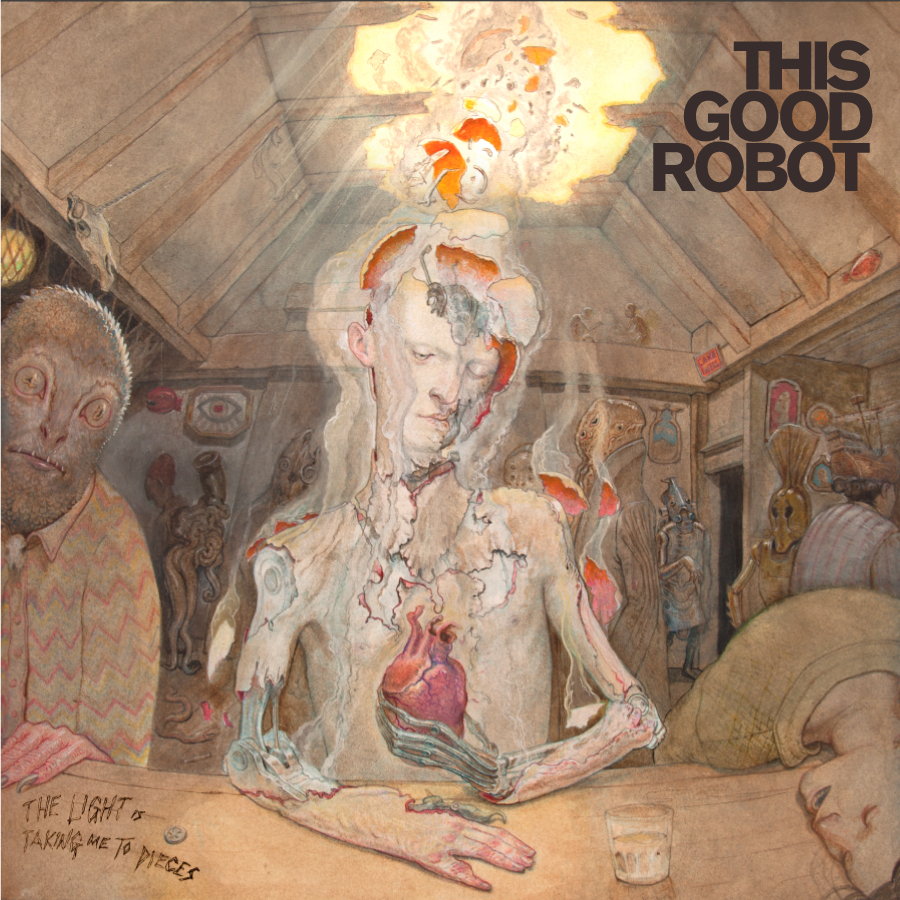
Album Review: This Good Robot - The Light Is Taking Me To Pieces

I've written before about the democratization of the music industry, and how the internet has made it possible for bands who are worthy to make a name for themselves, regardless of having the backing of a label. I've been able to find and champion a few bands and artists over the course of my time writing about music who were finding their way on their own, but who were every bit as deserving of attention as the names we're all more familiar with. A few of them have even been picked up by labels since that time, just proving the point that a self-released record is no longer a scarlet letter that needs to be apologized for.


This Good Robot is one of those unsigned bands that makes a strong case for the beauty of taking music directly to the people. Opening with the title track, the band makes a statement with those first four minutes. Setting the scene with a far-away country ballad, the song bursts forth with tinkling pianos, swirling guitars, and a melody that blends punk and theater. Even the instrumental break is unexpected, with a sound that is anything but a distorted guitar wailing away on high notes. There's a fluid musicality to what is going on that makes the song sound like something fresh, something bigger than a little song sung by a little band.


“Bleed 'Em Dry” follows with a more standard punk aesthetic, strongly bringing AFI's glory years to mind. The guitar parts are deceptive with little bursts of syncopation, and the chorus explodes with energy. The experimentation and genre-hopping continues with “Super Spy”, which opens with stabbing strings that bring to mind the inevitable comparison to “Eleanor Rigby” (has a single sound ever been so identified by and with only one song?). The second verse has a swinging feel to it, and the chorus is pure, pompous melodic bliss. As far as opening salvos go, this trio is a strong shot.


From there, the album continues to spin in varying directions, never staying too long in one place. Some songs veer off into heavy punk energy, while others relax and bring the sensation of being a ballad without actually being one. Then you get to “Call The Police”, which twists the very way the band plays their instruments, shifting into a more intricate collection of guitar figures that feel unlike anything else on the record.


As odd as the album sounds like, on paper, there is a perfect comparison to be made here. This album sounds remarkably similar in spirit to last year's phenomenal debut from Incura. Like that album, this one is a mix of punk, hard rock, and theatrical sensibilities that come together in a weird, sticky blend of songwriting that is more multi-faceted than you would ever expect from a rock band. The refusal to adhere to the standard tropes is a smart move, because not only do the overblown moments stand out because of their cheesy awesomeness, they also make sure you're never going to confuse This Good Robot with another band. Like it or not, they have an identity that is unique to themselves, which is as important a fact as any band can establish, especially when they don't have the power of a label working to promote them.


And like the Incura album that I mentioned, my opinion of “The Light Is Taking Me To Pieces” is that it's an endearing, fun record that puts a smile on my face. The world already has more than enough music that is designed to make you feel terrible. Sometimes you want music to make you feel good, and This Good Robot can definitely do that.     

Sunday, May 10, 2015

My Take: Vinyl's Resurgence

Over the last five years, vinyl has encountered a renaissance, with sales spiking, and legions of fans and artists professing their love for the arcane format.  While I am a fan of physical products, and appreciate the renewed emphasis on owning a collection of music, there are elements of the vinyl philosophy that I cannot get behind; mostly the rampant confusion that leads people to incorrectly believe that vinyl is a superior audio format.

Every format we use to listen to music has limitations.  It is simply impossible for anything to accurately reproduce the entire spectrum of sounds that a band of instruments can create.  That much is not a debate.  What we are actually talking about, when we compare the formats available, is how they reproduce the sound, and which elements get left on the cutting room floor.  We are, therefore, talking about our preferences for how we like our music to be flawed.

What is not up for debate is that CDs are theoretically a superior format than vinyl when it comes to accurately reproducing as much of the sound as possible.  This might seem counter-intuitive, given how often vinyl is held up as the standard, but that urban legend comes bother from a misunderstanding of the science of sound, but more importantly from the fact that CDs have rarely been used to their full potential.

The fallacy began when CDs were first entering the market in the early 80s.  At that time, being new, the albums we were listening to were dropped straight onto the new discs, without making any adjustment for the realities of the delivery mechanism.  Vinyl did not allow for bass to be pronounced in the mix, to prevent the needle from jumping out of the groove.  While that was fine on a turntable, and because vinyl naturally enhanced those frequencies, it was murder on CDs.  Digital audio got a bad reputation because a mix that was intended for vinyl was put on the CDs, with the low bass levels required for the old format never compensated for.  What CDs did was show how much a mix had to be skewed from what it was supposed to be for vinyl to sound good.  But because producers did not yet know how to make music for the digital format, the thin sound that was first offered up became tautological proof that CDs weren't as good.  That is wrong.

Decades later, as the loudness war has been in full force, the same type of situation is occurring.  As volumes have been pushed past the point of no return, CDs have been offering people music that sounds sub-optimal.  The vinyl copies of many of these albums sound superior, but not because of anything the vinyl is doing, but instead because the producers have to make better versions of the album to avoid the record not being playable.  Because those issues do not arise with digital formats, producers have become lazy, sloppy, and no longer care about the quality of the product they are putting out.

When you listen to a record like Metallica's "Death Magnetic", the audible clipping and disturbingly poor sound quality has nothing to do with the digital sound, but instead lies in the production choices.  It's hard for people who don't have insight into the recording process to make these distinctions, which the vinyl crowd has jumped upon.  When new albums come out, and people clamor to say the vinyl sounds better, they rarely if ever make note of if it's even the same mix being put on both formats.  If the sound is not being optimized for both, there is no fair comparison to be made.

What is more frustrating is the fact that vinyl is being hailed as the 'true' way to listen to music, as being more natural, when the vast majority of albums being pressed were recorded digitally in the studio.  They are not truly analog recordings, so they are no more authentic than the CDs that have fallen out of favor.

But more than anything, what frustrates me is that great sounding music is not something we appreciate and demand.  We have become so willing to tolerate sub-par sound quality that a vinyl copy of a digital album somehow sounds like a revelation.  CDs are capable of some of the most astounding audio you will ever hear, but we seldom get that, because neither we nor the record companies think anyone wants it.  I use this as an example: Nightingale released their new album earlier this year, "Retribution".  It's a very good sounding album that is one of the best of the year.  But if you seek it out, there is a special edition of the album with a mix intended for the vinyl, where more of the natural nuances and dynamics are left in tact.  It is properly produced music, and listening to that mix, even as a download, is a thing of wonder.  That is what music should sound like, that is what music can sound like, and as long as people are buying vinyl because they have been deceived into thinking that anything pressed on wax sounds better, we're never going to get the music we deserve.

As consumers, we need to know what we are consuming.  We seldom do, and that has led to the destruction of music.

Thursday, May 7, 2015

Album Review: Kamelot - Haven


Kamelot has managed to do two things that should not coincide; they have become possibly the biggest name in power metal, while at the same time disappoint people at every turn.  It started with the last couple of albums with Roy Kahn falling into too similar a pattern, then continued when Tommy Karevik replaced Kahn, but sounded too much like he was trying to mimic his predecessor.  When fans are always grousing about what you're doing, it stands to reason that the band would be receeding into the shadows, but that's nto what has happened here.  Somehow, Kamelot has managed to expand their profile, despite the criticism, which illustrates a skill that I can't quite put my finger on.  Now with their second album since Kahn has left, I have to imagine the grace period is over, and they have to deliver on their promise.

"Haven" doesn't stray far from the Kamelot playbook, with another dozen or so songs of dark power metal that chug through simple riffs and Gothic atmospheres.  If you think you've heard it all before, you're not exactly wrong.  Kamelot isn't reinventing the wheel, because there isn't a need to do so.  They still have mileage to get out of this sound, and to be fair, asking them to abandon a sound that they pioneered isn't rational.

Musically, Kamelot has never offered up a mix of tantalizing and interesting ideas.  The guitars usually chug out simple note sequences, or strum chords through choruses.  This isn't a band you listen to for the great guitar playing.  It's all well-executed, but there is rarely a riff in a Kamelot song that you're going to have playing through your mind on an endless loop.  What makes Kamelot great are the songs, the sweeping melodies that you can sing along to and always feel uplifted, despite the somber tones.

And that is why Tommy was the perfect choice to be Kamelot's singer.  As we've all heard in his other band, Seventh Wonder, he is capable of writing earworm melodies in the most complex of metal, which is much harder than it sounds.  Kamelot's music is such that it depends entirely on the vocalist to breathe life into the songs, to carry them with charisma and melody.  To that end, Tommy does a fine job, bouying the songs with melodies that are warm and inviting, throwing more of his personality into the mix.  If "Silverthorn" was disappointing for any particular reason, it was that Tommy had been relegated to playing the role of Roy Kahn.  Here, he is given more room to be himself, and it makes a huge difference.

"Citizen Zero" is a highlight, with a modern, heavy edge to the guitars that could have been written by Zakk Wylde, if he knew how not to overdo every trick he knows.  It's interesting, but can easily go downhill, except that Tommy uses that to set up a chorus that completely turns the song inside out.  It's a beautiful bit of songwriting, and is what Kamelot does best.

In fact, from top to bottom, "Haven" is as melodic and catchy an album as I've ever heard from Kamelot.  Part of that lies in the fact that I never succumbed to Roy Kahn's charms the way so many other people did, but most of it has to do with the fact that the band has put together a rock solid album here.  Every song has a chorus that reaches for the brass ring, even if they don't all quite get there.  "Liar Liar" is a bit weak, but songs like "Under Grey Skies" and "Beautiful Apocalypse" can't be denied.

The only issue I have with the album is that, like all Kamelot albums, the darkness of tone makes it hard for me to really embrace what's going on here.  I don't need, or want, the music to be fluffy pop, but there's only so much enjoyment that can be wrung from the darkness.  I would like a bit more brightness to the mix, just to make it sound more fully fleshed out.  If it's supposed to be a punch, the production takes the sharpness out of the jab.  But other than that, "Haven" is a definite improvement over "Silverthorn", and makes the case for Kamelot's popularity.

"Haven" is a strong record, and Kamelot fans should be quite happy with it.

    Tuesday, May 5, 2015

    Album Review: Impellitteri - Venom

    One of the things I've never been able to wrap my head around are the neoclassical shredders that came to prominence in the 80s and 90s.  On the one hand, I can see why guitar players would be drawn to those players who can rip up their fretboards with riffs and solos of blinding speed.  It's certainly an impressive skill to have, but a skill is about all it is.  Most of those players, aside from the sheer speed, were not very good as actual musicians.  They could play the hell out of their guitars, but they couldn't write songs, and they couldn't make albums.  Need I point to Yngwie Malmsteen here?

    Chris Impellitteri is different than a lot of those players, because he's worked most of his career in a band setting, and with one of the more talented vocalists his brand of power metal has known.  Rob Rock is not just a superior vocalist, but he has grown into a formidable songwriter as he has gotten older.  His solo work with Roy Z stands out as some excellent material.  With the two together again for a new Impellitteri record, the stars have aligned for them to finally reach their potential.

    The title tracks leads off the assault with blistering riffs, and Rock's vocals soaring atop the metallic fury.  But the song isn't two disperate elements fighting to work together.  They integrate into a cohesive song, as Rock balances the guitar flourishes with a simple and sticky melody, while Impellitteri's guitar gives chunky heft to Rock's lighter touch.  They strike a balance that is important for any band.

    "Venom" is an album that goes for the throat, with ten short bursts of energy, only one of which hits the four minute mark.  That can sometimes make an album feel a bit underdeveloped, but in this case, I would consider it a strength.  The guitar playing is of a style that I would find tiring if it stretched on for nearly an hour.  By keeping the flurries of notes shorter, each song is crafted for maximum punch.

    I particularly like the more 80s hard rock style of "We Own The Night", which dials back the aggression just a bit, and gives Rock plenty of room to put a big hook atop the chorus.  From top to bottom, this is the best set of songs I've ever heard from Impellitteri.  Of the ten tracks, the only misstep is "Rise", which pounds away without much of a melody.  "Nightmare" is as chunky through the verses, but it stops and opens up into a gorgeous chorus, which is what the former song should have done as well.

    That being said, "Venom" is an album that deserves its praise.  Impellitteri has never impressed me much before, but this album is a tight and focused bunch of songs that knows exactly what it wants to do, and makes no excuses for it.  Impellitteri's guitar work is as fiery and quick as ever, but that's not what makes this work.  He uses his skills to still play songs that have simple enough riffs and grooves, and then Rob Rock makes it all work with his voice and melodies.  If these songs didn't work as simple sing-alongs, it wouldn't be nearly as enjoyable.

    Sure, "Venom" is a bit of a short album, and "Time Machine" too blatantly copies some moments of "The Trooper", but it's an album that does shredding guitar proud.  Compared to an album from a similar player like the recent DSG album, "Venom" is a reminder that great players can still make really good albums.

    Sunday, May 3, 2015

    Album Review: The Tangent - A Spark In The Aether Volume Two

    For all the talk about what progressive rock is or isn't, one thing is very clear; the majority of progressive rock bands stick fairly close to the original Yes/Genesis mold.  There's a very good reason fro this, since that is the sound that initially became popular, and it's the one that still leads to the greatest amount of success.  Unless you up the heaviness quotient enough to become a metal band, the retro prog sound is the one that will most readily get you noticed.  The Tangent are one of the many prog bands that was assembled form the parts of other prog bands, centered around Andy Tillison.  Originally carrying much of The Flower Kings in their personnel, the band has evolved as the albums have rolled along, although still retaining the upper-echelon players you would expect.

    "A Spark In The Aether" is a conscious callback to the band's first album, which is a bit of a meta-reference, since that album itself was rather grounded in the prog of the 70s.  This time, we get an album that recalls an album that recalls the past.  If that's not enough to make your head hurt, it's also a bit of a concept record that runs over an hour, and contains a twenty minute epic.  Ah yes, the joys of prog.

    The album kicks off with the title track, and a fuzzy synth line that instantly tells you what this album is going to be all about.  The main gist of the song is a bouncy bass-line, leading to an upbeat chorus, all of which is a great way to introduce the weightier pieces that will come later on.  Opening with a short burst of strong songwriting is a smart decision. 

    The oddly titled "Codpieces & Capes" is the first of the extended compositions, one that directly addresses the excesses, and ridiculous nature, of much of the progressive rock bands of the 70s.  I can't quite decide if the song is nostalgic for those good ol' days, or if it's taking those bands to task for going so far over the top that they killed prog for everyone who came afterwards.  I think both arguments can be made.  As for the song, Tillison's synths dominate the mix, leaving no mistaking whose band The Tangent is.  But listening to the quieter moments of the song, it makes me wonder a bit about the production choices, because the synths distort in an unpleasant way as the volume increases.  It's a bit f unnecessary distraction in what is otherwise a fine multi-part epic. The second section, in particular, is a wonderful reflection of the sound The Flower Kings have been mining on their recent albums, and stands out as a highlight of the entire record.

    Especially when contrasted with a song like "Aftereugene", an instrumental that's half acoustic guitar exercise, and half smokey jazz lounge interplay.  How the two connect isn't quite made clear.

    "The Celluloid Road" is the album's centerpiece, a twenty minute rumination on the influence of American pop culture on the world.  I take it as unintentional irony that the message is being delivered through a style of music that was conceived in Europe, and for the most part only exists there anymore.  The song bobs and weaves as it moves through its sections, with a large amount of Neal Morse's instrumental feeling popping up in the seques.  It's a deft composition, and there's a lot to like, but the lyrics are too ham-fisted for their own good.  This kind of prog needs a more refined, more metaphoric message.  These words are so blunt that it takes away from the sophisticated playing going on underneath them.

    But the real shame of the album is not just the lyrics, but how they're delivered.  Simply put, Andy Tilliman isn't a good enough vocalist to pull off what he's trying to do here.  His voice is fine in the quiet, soft moments, but he takes on a tone of a congested Morrissey when he pushes himself.  He never comports himself with the feeling of confident aplomb that the instrumentals carry.  If he recruited a better singer, or even someone like former member Roine Stolt, whose voice is fascinating in place of fantastic, this album had a world of potential.

    "A Spark In The Aether" does indeed have a spark to it.  The songs that are written are some very good, engaging progressive rock in the vein of the classics.  Unfortunately, those really good songs are not presented to us in the best possible light.  From the vocals, to the slightly dour production, there are places where this could have been a far better album.  That being said, "A Spark In The Aether" is still a fine example of how to make modern progressive rock.  After all, it's not like those classics are perfect anyway (that's a debate for another time).

    Thursday, April 30, 2015

    Album Review: Forever Still - Save Me [EP]

    I've mentioned this before, but I think it's worth repeating; rock music needs more female vocalists.  I don't mean bands like Nightwish or Epica, where the singers are classically trained sopranos who sound like angels splashed across a metal backdrop.  I'm talking about straight-up rock singers, the kind who have heart and passion, who make you feel with their voices.  They are few and far between in good bands, which is a shame, because many of the good ones are far more effective than the majority of bland men who get to front these groups.

    Forever Still is a band I came across on Twitter, and they have one of these singers.  Maja Schønning is the centerpiece of Forever Still's appeal, sounding not unlike an unknown version of Lzzy Hale.  And yes, that is high praise.

    "Save Me" is the band's newest EP, which offers up three tracks of modern hard rock that follows the template laid down by their previous self-released efforts.

    We open with "Awake The Fire", which starts with a jumping guitar figure before the rest of the band propels the song with a bouncing energy.  Maja's voice takes control through the short verse, which is biding time before the chorus comes along.  Here, she opens up a bit, and the melody lands a few punches.  It's clear that she's still holding back a bit, which is smart, because it leaves us wanting to hear the rest of what she's capable of, and because this music can be killed by oversinging.  At a taught three minutes, it's a short burst of heavy energy and catchy melodies.  I would have liked another thirty seconds to flesh things out, but it's hard to complain too much about a band that edits themselves so well.

    "Breathe In" kicks off with an even heavier riff, tuned down to give the song a darker feeling.  Maja again dominates the song with her vocals, as the deeper guitars give her even more room in the chorus for her voice to shine.  It's a slightly less poppy melody, but still an effective that stands toe to toe with anything I would be hearing on mainstream rock radio right now.  And to top it off, Maja unleashes a harsh vocal to introduce the bridge, which is startlingly good.  If the band decided to move in a dual vocal approach, even though it's not my favorite style, she clearly has the pipes to do it.

    The title track closes things out, as the sound of falling rain plays against a clean guitar arpeggio.  The melody is perhaps the most commercial of the bunch, but with the heavy strummed chords underneath the vocals, there's a reason the formula has worked for as long as it has.  The band changes things up with a bit of an unusual drum pattern in the second verse, while Maja's vocals play with her upper register in the bridge.  As the longest song of the three, it feels a bit more fully developed than the others, and uses its extra time to build on its atmosphere.

    It's tough to judge music in short doses, but an EP like this can give an insight into whether a band has the skills to make it to the next level.  Listening to "Save Me", it's amazing to realize that this is an unsigned band.  They can write damn good songs, Maja is an amazing singer, and the production bests many of the big name releases I cover.  If this is the appetizer, when they finally get around to releasing a full album, count me among their fans.  Forever Still is a band with unlimited potential.

    Tuesday, April 28, 2015

    Album Review: The Dreaming Tree - Silverfade

    Alternative rock has, for most of the time my memory spans, been a wasteland of dour attitudes and terrible music.  After the grunge movement rewrote the expectations of what rock was supposed to be in the mainstream, we were treated to band after band, now generation after generation, of what was labeled "post grunge", but what was really a facsimile of something that wasn't all that exciting to begin with.  And like any carbon copy (if you remember that process, congratulations), the results could only get worse with time.

    But what the solution to our problem is can't be said to be clear.  We've seen increased heaviness, the acceptance of harsh vocals, and we've seen more than one attempt to right the ship by going back in time.  None of them have really worked, because they didn't strike at the core of what makes alternative rock as we know it so boring.  The Dreaming Tree tries a different approach, by stretching out and taking it in a more progressive direction.

    "Silverfade" bounces from style to style, never staying put in a single sound, which allows the record to not become one long, dingy slog, which is a problem that permeates a lot of alternative rock.  "Yesterdays Tomorrow" opens the record, unexpectedly, with a piano figure, and when the guitars do come in, they are not the thick and low slurry you would expect.  They are still fuzzy, but they sit in the mix with a sharper bite, and they flick out washes of chords to give heft to the composition, which is clearly not written solely for the guitar to dominate.

    "Heart Shaped Bruises" is a more traditional alternative song, with a bouncy beat and a synth line that pops up and recalls the short-lived video game fad that popped up during Ozma's brief foray into popularity.  The song's title also recalls an obscure song from a late-era Elvis Costello album, which is always a winner in my book.

    After a bout of organ-washed poppiness, things get interesting with the eight minute "Forever Not Forever".  The song digs a bit deeper, giving the guitars more heft as they chug through the verses before lifting into an ethereal chorus.  This song shows the decided influence of prog, with riffs that twist and build like something you would hear in a Dream Theater song.  What that does is twist the normal alternative playbook around, giving us something that we probably didn't see coming.  Needless to say, it's the most engaging of the songs in the album's opening half.

    There's a lot to like about "Silverfade".  The diversity of the album goes a long way towards justifying its sixty-five minute running time.  That's a lot of music, but the fourteen songs here all offer up something slightly different.  "Cherry Winters" does a great job of blending 60s vocal harmonies to a jazz chord progression, while "Higgs" has the dark atmosphere and Tool-like drumming patterns to slide into a radio playlist without a problem. 

    But there are things about the record that could use improvement as well.  First of all, over an hour of music is just too much.  The record could have been two songs shorter, and better for the editing.  More than that, everything is just lacking a bit of focus.  The guitar tones are too soft and fuzzy for their own good, needing a bit more clarity to the attack to really make them feel as though they are a true rock band.  The biggest issue is in the songwriting, which while solid, lacks the true hooks that the music is begging for.  There's a lot of nice melody, but it's so soft that it never digs in.  There isn't a hook here that you know as soon as you hear it is going to get stuck in your brain.

    "Silverfade" is a record that tries to do a little bit of everything, and I think suffers for the effort.  If the scope had been narrowed just a bit, there's a lot of potential here for something to have been really good.  As it stands, "Silverfade" is a fine record to put on and enjoy, but I don't see it as essential listening.

    Sunday, April 26, 2015

    My Take: Star Ratings (And Why I Don't Use Them)


    Not to make myself sound old, but I've been writing about music on various blogs and websites for at least a decade now.  In that time, I've tried my hand at virtually every format under the sun.  I've written long-form, short-form, detailed, big-picture, and everything in between.  I have also, as astute readers will note, not been using any sort of rating system here.  That is a carry-over from the way we did things at my previous online home, but it is also a choice that serves a specific purpose.

    If I'm being honest, I too appreciate the shorthand that appears at the bottom of a review, saving me from having to spend the time reading an entire piece before realizing the author disagrees with everything I believe about music.  There is value in being able to take a quick look, see the end result, and then go back and decipher the manner in which it was arrived at.

    However, that can be used as a particularly nasty strain of self-reinforcement, where a rating can enable a reader to avoid any hint of a dissenting opinion, no matter how well-reasoned it may be.  We learn from hearing other people make arguments we wouldn't have thought about, when our beliefs are challenged in ways that make us think about why we hold them, and whether they have become mere reflexes.  Without that outside push, it's easy to fall into a cycle of delusion, where our opinions slowly change like a children's game of telephone, and we never are able to see how far we've drifted from what we actually believe.

    As a writer, I want my words to mean something.  Putting either a number, or some stars, at the bottom of a review negates the power of the written word, because it reduces complex thought into an simple numeral.  I can give two albums the same score on a numerical basis, when my opinion of them is radically different.  A record that should have been great but misses the mark, and one that should have been terrible but overcomes its shortcomings, will settle in the same area of the grading curve.  But they will not be the same thing, and I will not remember them in the same way.  Any ratings system has the unfortunate, and irreparable, problem of trying to simplify something that cannot be.

    Our thoughts are not simple equations.  They are complex maps of battling impulses, trains of logic that run down a dizzying map of tracks.  Just like there are myriad ways of traveling from one side of the country to the other, there are different ways of arriving at the same rating for an album.  It would be a disservice to anyone reading to not explain how I actually feel about a record, and why I came to that conclusion.  That can't be done with a simple rating.

    Maybe I'm just long-winded, and like the sound of my own words, but I genuinely believe that there is more to be gleaned from a well-written review than a rating can tell me.  That information is what will pique someone's interest, that information is what will make them decide they need to hear a record for themselves.  Seeing five little stars at the bottom isn't enough to do that, not when there are thousands of other choices.  It's the description, the reasoning, the writing that goes beyond simply saying "this is good" that can reach out and change someone's mind.

    And yes, there is also the practical matter, that putting ratings on albums as they come along carves that opinion in stone.  That goes without mentioning that a ratings system can be as confusing as a muddled opinion.  If I rate an album with four stars out of five, I would consider than a ringing endorsement, a statement that an album is a great piece of work.  Someone else will look at that, do the math, and conclude that I have given that album the elementary school equivalent of a B.  Giving out five stars should not be taken lightly.  That score should be reserved for albums that go above and beyond, albums that strike at your very core, the ones you know will live with you for the rest of your life.

    Every person writing reviews would have to explain their own version of a ratings system, which would take as much time and patience as simply reading a better review in the first place.  My version of a four star record is probably different than most other people's, so what would we be gaining if I put the stars at the bottom?  You would still be lacking clarity, because you wouldn't know what they mean.

    I say all of this to explain why I am taking the path that requires more investment from the readers.  In the end, I think that all involved, you the reader, me the writer, and the artists, benefit from this arrangement.

    But for the sake of illustrating the point, here are the star ratings for the albums I have covered here:

    Sleater-Kinney - No Cities To Love: ****

    UFO - A Conspiracy Of Stars: ****1/4

    DSG - Still A Warrior: *1/2

    Nightwish - Endless Forms Most Beautiful: **1/4

    Halestorm - Into The Wild Life: ***

    Europe - War Of Kings: ****

    Karnataka - Secrets Of Angels: ****1/4

    The Pinder Brothers - Melancholy Sea: ***

    Exovex - Radio Silence: ***1/2

    Vola - Inmazes: ***

    Tribulation - The Children Of The Night: ***

    And for good measure, two albums from earlier in the year:

    Nightingale - Retribution: ****1/2

    Jorn Lande & Trond Hotter - Dracula: Swing Of Death: ****1/2

    Tell me; do those help at all?