Monday, September 14, 2015

Album Review: Leaves' Eyes - King Of Kings


There's an odd trend in metal right now for bands to take up history as a subject, writing albums that aim to serve as much as textbooks as they do entertainment. You have bands like Sabaton and Hail Of Bullets telling the history of war, while others have taken up the cause of various kings and queens. The former I can understand, since war and metal do share inclinations that would bring them together. I'm not sure I understand the appeal of writing about royalty, since I can't see why any of us would be so interested in giving credence to such a painful system of rule. It's very much like how I can't believe the American media spends so much time fawning over the movements of the British royals, when we fought a war a couple centuries ago precisely so we would be free of them.

Leaves' Eyes steps in with their new album, telling the story of Norway's first king. Since I don't know his story, I'm not going to be judging the album's historical accuracy. Let's just see how it stacks up as a piece of symphonic metal, shall we?

All albums of this sort apparently must have a symphonic introduction, which we get here in the form of "Sweven". It's a harmless two minutes of violins and folk atmosphere, but it's also useless time that doesn't do anything to ramp up the first real song, since it starts with it's own form of an introduction. That track is the title track, and it sets the statement of how Leaves' Eyes is out to make an album that is massive and epic. Unfortunately, trying to be epic and actually being so are very different, and this song proves that point. There are big guitars, big choirs, and big strings, but the composition itself is stock-in-trade metal. The extra layers of sound don't change the fact that it's a very conservative song, one that doesn't have much of a riff or a melody beyond a few drawn out notes, so the whole of the composition doesn't add up to much that's interesting.

"Halvdan The Black" tries to improve on things, built from a sturdier metal riff, but there's a disjointed nature to the writing that doesn't work. The verses drop down into drum-and-bass emptiness for no real reason, and the chorus strips away Liv's melodic voice for a staccato shout that's backed up with poorly done rough vocals.

"The Waking Eye" follows the same basic formula, but has more of a melody to follow in the chorus. Letting Liv sing is obviously the band's best bet, so why they don't write material to highlight her voice is a mystery to me. I suppose that's why the guitars drop out in nearly every verse, but that's a writing cliche that is just as annoying, since the songs can never maintain any sense of urgency if they have to always slow and soften to accommodate her.

"Vengence Venom" is more fun, with it's Celtic influences, and it's slightly more spritely pacing. By the time we reach the mid-point of the album, we've already heard everything there is to hear, and a verdict can be rendered. "King Of Kings" is one of those albums that tries so hard that it can't possibly hit its mark. Writing epic metal takes a songwriting perspective that is different from slapping extra layers of sound onto a regular metal song.

That latter approach is what I hear with this record. It's standard metal that gets dressed up with extra fancy bits, but they don't change the core of the sound. Leaves' Eyes is writing regular power/traditional metal songs, and they aren't doing it especially well. There are a few good tracks here, but the album comes across mostly sluggish and bloated. Liv is clearly a good enough singer to build a sound around, but she is never given the space and melodies to shine. It's a shame, because I'd like to hear her really let loose and see what she could do here. As it stands, "King Of Kings" is more interesting in theory than it is in sound.

Sunday, September 13, 2015

Album Review: Huntress - "Static"


In speaking with Huntress’ leading dynamo Jill Janus a couple years back, she explained in detail how the band had crafted an idea for a sort of neopagan or Wiccan trilogy, centered around the concept of the Triple Goddess – the Maiden, the Mother and the Crone.  Going in order, that makes the band’s new release “Static” the Crone, being their third full studio album to date, and Janus and company live up to the promise of a record that rails and howls against the dying light of the waning moon.

From the jump, Janus puts her impressive vocal range to the fore, belting out surprisingly high and virile measures from her slight frame for opener “Sorrow” and “Flesh.”  The musical accompaniment beneath her vocal panoply is appropriately rugged, turning up the distortion just so much as to be threatening under the veneer of even Janus’ flighty vocals.

But what makes “Static” stand apart from the band’s previous albums “Spell Eater” and “Starbound Beast” is the infused sense of urgency.  There’s a desperate anger branded into the very flesh of these songs, the kind of semi-blind striking out that not only fits perfectly into the greater theme of the Crone, but also would have made Dylan Thomas proud.  There is a palpable sense of fury and regret and Janus slashes her way through “Brian,” a song almost certainly about somebody but representative of a greater sense of loss and pain at the end of a relationship or a life.

Produced at least in part by James A. Rota of Fireball Ministry, his musical influence meshes well into the established goal of the Huntress trilogy’s endgame; to represent an anguished soul striving for a little more time and exacting retribution on those who wronged her.  “Mania” is a long, twisting diatribe of hurt that weaves in many different influences and colors, but the middle third is where it’s not so difficult to detect the burning, thick guitar tones and cadences of Rota’s primary band in the lining.  The addition lends the experience of “Static” a certain authenticity as the last, vengeful gasp of a fading goddess.

We experience the same kind of churning rhythm for much of the album’s back half, be it the quasi-thrash of “Harsh Times on Planet Stoked” or the slugging punch of “Noble Savage.”  Huntress’ consistency is thorough and well-orchestrated.  There are no outliers on “Static” and each individual track, even the ‘happy’ ones, stick to the overall tone of the album.

The only thing “Static” is really missing in terms of execution is a unified, killer single.  There’s not one of the ten tracks (twelve depending on which version you buy,) that stands solidly above the rest to command attention, which isn’t fatal by any means, but does mean that the whole experience melds together into one long piece perhaps a shade too easily.

In addition, while “Static” commits to its presentation and executes with style and aplomb, the emotional toll of the album isn’t especially exacting.  Janus’ performance is uniformly good and there’s nothing wrong with the music that accompanies it (and sometimes outshines it!) but if the listener is seeking an album that truly evokes the clawing pain of a life lashing out, “Static,” while painting a convincing picture, doesn’t quite hit that button in same way that say, Alice In Chains’ “Dirt” does.

With all that, though, let’s not sound too down – “Static” is Huntress’ finest record to date, and is enjoyable in that same way that many believe “The Empire Strikes Back” to be the best “Star Wars” movie.  The writhing and vitriol of Janus’ Crone takes the band in a direction that is similar to their traditional heavy metal roots of years past, but adds depth and dimension to the performance.  Fans of THM in particular will enjoy the record, but most everyone will find a little something to like.

Thursday, September 10, 2015

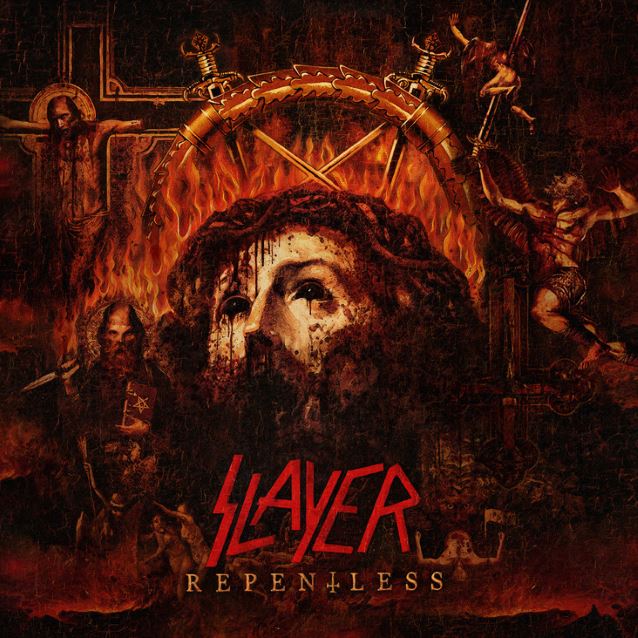
Album Review: Slayer - Repentless


Slayer is at a crossroads, that much cannot be denied. When Jeff Hanneman passed away, there was an existential crisis to endure, questions about whether Slayer would still be Slayer without half of the their creative team. Going out on the touring circuit and pounding out the classics is easy, but to create vital new material without the engine running on full power is something else entirely. I'm not going to beat around the bush here. I'm still not sure if Slayer should have gone on as a recording unit. I'm never going to question whether they [can], but I'm not fully comfortable with the fact that they have. Hanneman was simply too important to be replaced by more of Kerry King. Suffice it to say, my excitement and expectations for this new album were not very high.

The album gets one thing right from the very start. If you complained about the thin guitars on "world Painted Blood" (I didn't - I like natural recordings), that problem is gone. Terry Date's production is huge here, with the guitars still retaining Kerry King's less distorted tone, but sounding as massive as ever. Sonically, despite being brick-walled, the album sounds fantastic.

After a slow, creepy bit of an instrumental, we kick things off with the title track, which we have all heard by now. It's Slayer by-the-numbers, which means it should please Slayer fans. My opinion hasn't changed from when it was released prior to the album, namely that it's a perfectly serviceable song, except for Kerry's awful lyrics. That has been a problem going back for several albums, one that makes me curious how someone can spend thirty years as a songwriter and get worse as a lyricist. His nadir will forever be the god-awful "Payback" (despite it being an amazing, catchy song), but he hasn't bounced back far enough for me to not still shake my head at many of these words.

"Take Control" is a far better track, mainly by virtue of it's relative diversity. The main riff is another of those chugging as fast as possible bits that doesn't really feel like a riff, but then the song drops down into a much heavier muted riff that actually hints back at 'that riff' from "Angel Of Death". The vocal lines still aren't the strongest, but the guitars on this one are more than enough to make me forget about that.

The slower numbers are hit-and-miss. "When The Stillness Comes" is a bland, forgettable number, but "Vices" is a surprisingly solid effort. The slightly slower tempo not only allows the song to sound heavier, but it fits Tom Araya's voice so much better than the frenetic numbers. Without struggling to keep up with the music, Tom's voice actually sounds comfortable, and the whole of the song comes together in a nice package.

It's when we finally get to the first song released from the album, "Implode", that it hits me that this has been a much slower album than I was expecting. The whole of the middle of the record was on the slower (for Slayer) side. What that does is allow the band to find some groove for the first time in ages, which helps the songs differentiate themselves from one another. It also gives Kerry a different foundation to write from, so his vocal lines don't dip into self-plagiarism as much as a few of his recent efforts have.

The highlight of the record for many people will be "Piano Wire", the lone song written by Hanneman. It just feels a bit more like Slayer, and offers up one of those little bits that reminds you of what's missing in the form of a ringing chord in the verse that has the perfect amount of unintentional atonality.

When it's over, there's something I can say about "Repentless" that I didn't expect going in; it's a pretty good modern Slayer record. I had my concerns about Slayer at this point in their career, but I have to admit that "Repentless" is a better record than I would have predicted. You can't compare this to their 80s era, since everything is so different now. But compared to their recent material, it stacks up well. "Christ Illusion" is easily my favorite modern Slayer record, and "Repentless" slots in admirably behind it. I'd say it's a slightly better record than "World Painted Blood", and guarantees that the Slayer train isn't going to be stopping just yet.

Wednesday, September 9, 2015

Album Review: Ramon Ortiz - "Portal"


When composing a virtuoso guitar album, it stands to reason that the individual involved had better be damn well prepared to articulate a story without the use of lyrics to move the narration.  Unless one wants a fanbase entirely composed of technical guitar nuts, who certainly exist but perhaps not in substantial numbers to move a lot of product, composing living, breathing songs in favor of simple guitar theatrics is the crux of success in this particular splinter showcase.  It’s a fickle reality, one that has alternatively embraced, forgotten and embraced again by such luminary talents as Eric Johnson, Yngwie Malmsteen and Buckethead, with Joe Satriani, Steve Vai and John 5 also in the mix.  The internet is positively festooned with technically excellent would-be session players, men and women who regard as foreign the idea that truly otherworldly guitar composition is as much about character and tone and presentation as it is pace and ability.

Enter into this world Puerto Rican guitar sensation Ramon Ortiz who came to initial prominence as a founding member of Puya and later of Ankla, who presents us with his second solo guitar effort, “Portal.”  The album finds Ortiz about halfway down the line between the extremes of excellent instrumental storytelling and just-another-wanking-guitar-album.

What separates Ortiz from his peers in the genre is his abundant use of Latin influence in his music, carried over no doubt from both his band experience and his own deeply personal music history.  Indeed the most interesting part of “Portal” are when Ortiz drops his exclusive rock and metal sheen and fully gives in to his heritage.  We see tastes of this during “Jamakeo,” a song of traditional Latin percussive cadences overlaid and perhaps slightly overpowered by the characteristic drive of Ortiz’ personal tone.  This song though, shows the promise of what can be when Ortiz applies his composition talent to two generally separate musical devices.

A little ways down the line, this gives way to “Valse Criollo Natalia,” which is a song of straight Spanish guitar and played beautifully.  It’s a fine contrast to the solid, thumping rock of the rest of the record, a gentle respite amidst a sea of turgid electric waves.  Even this song doesn’t blend the two worlds that Ortiz is trying to tie together, it doesn’t really need to in order to be effective.

However, that song serves as the gateway for “Portal’s” masterwork; “Selvatica” is the single place on the album where the full implication of combining metal and salsa come to a head.  Wonderfully buoyed by Latin percussion, the song’s edgy but catchy riff cadence sinks in and finds a home amidst the unlikely pairing of dance and electric rock.  Ortiz uses a simple staccato riff to simulate the hip-shaking rhythm while his drums accent and color the tone of his undulating guitar in a cyclical partnership that creates the presentation of something akin to a metal Latin rain dance.

The unfortunate side of “Portal” is that outside those moments mentioned above, the album is well-executed but no so different from any number of other guitar virtuoso records.  Many of the remaining tracks are artistically interesting but not especially innovative or captivating, resulting in a sort of shoulder-shrug reaction from the listener.  If that sounds particularly damning it may well be, but keep in mind that the bulk of what we’ve been talking about are the highlight moments, which are good enough to warrant the praise we’ve heaped so far.  As singles, those are fantastic and worthy of high regard, but as a total package “Portal” may be only average, balanced out by material that is technically fine but does not snare the ear.  As discussed at the top, the remaining songs do not effectively pain an immersive picture.

So, by all means, give “Portal” a shot for the brilliance of “Selvatica” and the selected beauty and artistry of some other isolated moments, but be aware that you may be paying full price for an album that gives you reduced mileage.

Tuesday, September 8, 2015

Album Review: The Aaron Clift Experiment - Outer Light, Inner Darkness


This year, so far, has been a down year for progressive music. While the last couple of years have found me diving deeper into those waters, and walking away with some of my favorite albums of those years, I have not had the same luck this time around. For whatever reason, this has been a year defined by simplicity, and not even some of my favorite artists of the kind have been able to bring me back into the fold. The Aaron Clift Experiment has a better chance than many of those, because their take on progressive rock is not as mind-numbingly expansive as many, as the majority of the songs on display here are of manageable length, with only one headed past the ten minute barrier. It seems odd to say, but that's how I like my prog.

The album opens with "Kissed By The Sun", which introduces us to the band's sound with a riff of open guitar chords, and a striking bit of violin over the top. It catches you a bit off-guard to be introduced to those elements so early, but I like the choice very much. The violin work that weaves throughout the background is one of the best elements of the song, the sort of embellishment that can provide a lot of depth in just a few notes. There's also a surprising heaviness to the chorus sections, as the band locks together in a solid rock groove. Aaron's vocals don't have the personality that someone like Roine Stolt has, but he's a solid enough vocalist, and the melodies are lively.

A few jazz influences pop up during the instrumental section of that song, and those follow in the bass and electric piano groove of "Locked". The song is a highly melodic number that balances feelings of hope and melancholy. It's very pleasant, and its subdued nature showcases the searing lead guitar work that is prominent on the album.

Things get a little unfocused from there. "Fragments Of Sleep" lives up to the title, feeling a bit like a pastiche, a bit of song written solely to get to the counterpoint vocal section that closes it out. Neither half of the song works especially well, and together they just don't seem to fit. The following "Your Arms Hold Them To The Dark" is a thankfully short song that borrows the pace from doom, but doesn't have anything resembling a groove or melody to balance it out. It's a drag, and one of those songs that I'm not sure why musicians love to write.

"Aoide, Goddess Of Song" rights the ship, although it does sound a bit too much like the cloying stereotype of Christian rock. It's a pleasant song, but I can see why it could be considered too saccharine for most people. Much of this is proven by the nearly entirely instrumental "The Last Oasis", which uses the mix of guitars and strings to great effect, and has more heart in it than most of the songs with vocals.

We finish out the album with two more lengthy tracks, both of which move far too slowly, testing my patience. I've never much understood the appeal of atmospheric music, and these songs veer hard in that direction, not offering up riffs to glean onto. The appeal is very limited, given just how subdued the songs are for the entirety of the closing twenty minutes of the record.

I don't want to be too harsh on this album, but there are seriously glaring flaws that I feel I need to point out. The entire back half of the record is lacking any life at all, and once the first two tracks are over, Aaron barely has a melody to sing that's worthwhile. The band clearly has talent, and there are some nice instrumental ideas here, but the songs just don't have enough here for me to recommend the album. It's pleasant progressive rock, but that's about it.

Album Review: Quor - Human Paradigm


I'm starting to think that maybe I'm too hard on the 'mainstream rock' scene. While there is still the disgusting success of bands like Five Finger Death Punch that make me weep, there is actually some hope out there. This year has seen a very solid album from the new 'supergroup' Saint Asonia make a decent impact, and now Ghost has managed a top ten album. That alone tells me that the mainstream of rock doesn't have to pander to the lowest common denominator in order to succeed. While the scene isn't going to revert back to the old days, the ones I remember, where bands didn't have to have a sense of absurd macho roid-rage in order to be taken seriously, but there is some hope.

QUOR is introducing themselves with this, a debut album that collects tracks from their earlier EP. Having missed out on that, this is also my first exposure to the band. What do they have to offer?

"The Silence And The Spark" starts us off with a big, heavy riff played with a guitar tone that heaps on plenty of distortion. They're definitely going for something huge, although I often think that the opposite is how to actually make guitars sound beefier. The song reminds me of a song from Metallica's "Load", but played with the production of their 80s records. The vocal tone alternates between screaming and a Hetfield-esque shouted singing. The riffs are ok, and the chorus tries to be melodic, but the hook isn't polished enough to really stand out.

"When The Gods Speak" changes things up in the vocal department, as the bouncy riff segues into a verse that sounds like it could have come off a Volbeat album. And if you know what I'm saying, that's not exactly a good thing, since it's inexplicable how Volbeat is able to get away with it. The chorus, though, is solid, which really glues the whole thing together. It's a bit odd, but it's a pretty good song.

Through the rest of the tracks here, we get much of the same. The riffing is the standard modern rock tropes, and the vocals add a hint of strain to cleaner tones. The problem with all of these songs is that they simply aren't sharp enough. There's nothing egregiously bad about them, but there is also little that's memorable. There's a reason why modern rock gets called faceless, and it's because the chugging guitars never play anything that can be easily recalled by a listener. That's the case here, since while the songs are fine to listen to, I can't recall a riff from the record. That might be ok if the melodies were strong enough, but like a lot of bands finding their way, they need to be more finely honed before they turn these songs into killing machines.

A lot of young bands fall into this category, and Quor is no different. There are signs of optimism on this record, but it's a raw, embryonic document of who Quor are. Experience will help them develop their songwriting and their identity, but for now, "Human Paradigm" is merely a rough sketch of the future.

Sunday, September 6, 2015

Album Review: Amorphis - Under The Red Cloud


I've never gotten much into the scene that gets described as either 'dark metal' or 'melancholy metal', which is actually funny, because when I do hear some of these bands, they are often playing some of the most beautifully melodic metal of anyone out there. Something about the deeper side of emotions resonates in a melodic way that is highly appealing, as long as the underlying feelings don't begin to seep inside you and work their influence. I suppose that's why I've been hesitant to review more albums that fit the bill; I actively try to avoid music that I know is going to make me feel lousy. It doesn't work that way for everyone, and I've had arguments about this before, but depressing music isn't usually good for me. But when I hear the beauty a band like Katatonia can conjure, I'm willing to give it a chance.

Amorphis is one of the bands that fits this bill, turning out highly emotional metal that preys on the darker side of our emotions. But instead of turning that into bitter hate and ugly black metal, they remind us that there's something beautiful in all of the human conditions. Their music is not what you would call hopeful, but it is reassuring in the sense that the darkness is normal.

The album opens with the title track, softly introducing itself with a piano figure before the guitars come in with their ringing metallic crunch. There's guitar harmonies over the top of chugging riffs, while the chorus digs deep with growled vocals roaring over the maelstrom. Those death metal roots shine through in the tremolo-picked riff of "The Four Wise Ones". The song is much more interesting than that, with heavy folk influences that pop up and give the song a tantalizing flavor.

But it's on track three, "Bad Blood", that everything kicks into gear. That track is the perfect blend of heavy death metal through the verses, and soaring hooks in the chorus. Maybe you could say it sticks a little too close to the formula, but that exists for a reason. It's an absolutely killer track.

When Amorphis focuses on their hooks, the songs are uniformly great. "The Skull" and "Death Of A King" are similarly effective, and then "Sacrifice" strips away all the death metal elements for a dark pop sound that is startling in how engaging it is. Like latter-day Katatonia, it shows the beauty that comes from misery.

This might not be my style of music, but I don't need to be a fan to know quality when I hear it. My mood isn't often right for this kind of music, but when it is, "Under The Red Cloud" is a remarkably good example of how to do it right. I can't claim to have been familiar with Amorphis beyond their name before this, but they've made an album here that is the best thing I've heard all year with any death metal roots. Take my praise with the requisite grain of salt, since I'm not the usual audience, but "Under The Red Cloud" is great stuff.

Saturday, September 5, 2015

Album Review: Soilwork - "The Ride Majestic"


A review should never be about the reviewer, but permit me this minor indulgence just this once, as so much of my experience with Soilwork’s music is tied into my personal listening experience with their career to this point.  This is the only lens through which I can judge “The Ride Majestic.”

My relationship with Soilwork, long a favorite band of mine, seems to be in flux.  It comes upon a recently reflection that my three personal favorite Soilwork records, “Natural Born Chaos,” “Figure Number Five” (a personal all-time top ten record,) and “Stabbing the Drama” tend to be the three albums that many Soilwork devotees enjoy the least.  Nevertheless, as Soilwork rolls on with more records that are named with increasingly abstract titles, what keeps me attracted to the band is that there has always been a small handful of organically transcendent singles that either float the entire album (“Two Lives Worth of Reckoning”) or unlock the rest of the experience (“The Living Infinite I”.)  A certain amount of filler and experimentation has always been anticipated on a Soilwork record, because the band likes to channel their energies into a variety of artistic styles.

“The Ride Majestic,” by contrast, lacks those solidly rhythmic singles that have always insured that each Soilwork record remains firmly anchored to terra firma.  In their place, the band trades in an increase in multi-faceted metal, bordering on technical metal and accompanied by a wide range of new and different sounds from Soilwork.

And what a menagerie of looks we get from the Swedish veterans.  Perhaps most interesting is the sound of “Petrichor by Sulphur” which features an entire bridge sounding like a cut from A Pale Horse Named Death.  This is actually the most interesting part of the record, because it sounds so far afield from the normal expectations of Soilwork.  Juxtaposed by the slow but insistent melodic constructions on either end, this track ends up as the album’s crown jewel.

With that said, the album also experiments with the band’s more melodic side, incorporating some much more open and lighter fare for “The Phantom” and “Death in General” while also reverting to a more classic version of their idiomatic sound for many other spots on the record.
What colors most of these songs generally in that they have no one color.  Selecting “All Along Echoing Paths” as just one example, we see from beginning to end the technical side, thrash side and melodic side of Soilwork.  Other times there’s borderline black metal, atmospheric metal and a hundred other shades ranging from black to gray on the metal spectrum.

What stands as most interesting about “The Ride Majestic” from the standpoint of a longtime listener is that drummer Dirk Verbeuren, so long a metal craftsman who possesses intimate understanding of how to create atmosphere with his drums, seems content to reduce himself to metronomic percussion, rather than creating a feeling or setting a tone.  Yes, his beats for “The Ride Majestic” on expectedly on-point but come across as somewhat cold and antiseptic, disconnected at worst.

So, there’s something for every Soilwork fan, unless of course, you happen to be me, and the elements you always preferred to see the band utilize are conspicuously absent.  In a twist, fans going all the way back to “Steelbath Suicide” or “Chainheart Machine” may be lured back into the band’s good graces by their sonic assault.

Wednesday, September 2, 2015

Album Review: Iron Maiden - "The Book of Souls"


Chris C: I have been one of the most staunch defenders of Iron Maiden's reunion era. While plenty of fans were disappointed with the slower tempos and progressive bent, I was more than happy to hear the band not resting on their laurels, and fully embracing who they were at their ages. We've seen bands like Metallica and Judas Priest try to recreate their past, and it is almost always met with a sense of what once was. Iron Maiden has, by their choice, been making some of the most vital music of their career, producing four albums that, to me, are their 'classic era'.

"The Book Of Souls" is the most challenging album yet, a double record that showcases every facet of the band's modern sound. Throughout the ninety-two minute running time, we get some of the biggest epics the band has ever written, plenty of traditionally Iron Maiden heavy metal, and a few new twists and turns along the way. Aside from the curiosity that accompanied each change in singer, this is easily the most interesting Iron Maiden album to walk into.

I was concerned about the record being so long, as any sort of music is difficult to take for that long without it becoming stale. "The Book Of Souls" tries its darndest to be diverse enough to justify its length, and for the most part is succeeds. I still would have preferred a seventy-five minute single album, but there isn't anything on this record that I can easily write off as filler. That, by itself, is commendable.

There is plenty about this album that is easy to love. The Bruce Dickinson penned "If Eternity Should Fail" gets things off to a ripping start. Sounding like a cross between Iron Maiden's typical sound and his recent solo albums, it's a dark and heavy number that finds Bruce in fine form, with one of those melodies that only he can seem to come up with. The other songs he had a hand in, "Speed Of Light" and "Death Or Glory" are easily among the catchiest on the record. Janick Gers contributes two excellent tracks as well, as both the title track and "Shadows Of The Valley" use Eastern motifs that blend beautifully with the melodies given to Bruce. They're what you would expect from this incarnation of Iron Maiden, but that's not a problem. Great songs are great songs.

Then there's the oddity that is "Tears Of A Clown", which is one of the most straight-forward rock and roll songs I can remember the band writing. It almost sounds out of place on a record like this, but its low-key delivery works really well, and it's a nice diversion from the weightier pieces here.
But I have to say that, even though I am a flag-waving supporter of modern Iron Maiden, there is also a fair bit about "The Book Of Souls" that I'm not as fond of. Steve Harris' epic, "The Red And The Black", never sounds as vital to me as "Where The Wild Wind Blows" off of the previous record. In fact, several of the tracks with Harris' name on the writing credits lack bite, and don't have the strongest vocal lines for Bruce to sing. That makes a song like "When The River Runs Deep" come across a bit flat.

For me, though, the biggest problem lies in the decision to twice, in the epics "The Red And The Black" and Dickinson's "Empire Of The Clouds", stretch out the instrumental sections for upwards of five minutes. I understand they have three guitarists to cycle through, and the band is well-regarded for their solos and harmonies, but those breaks are too long to keep my attention. Particularly annoying is the break in "Empire Of The Clouds", because as a story that is trying to tell a story, the guitars don't move the narrative along at all. The song on either side is clearly something Bruce poured his heart into, but it just doesn't come together as well as I would have liked it to.

Overall, "The Book Of Souls" is an album I'm having a hard time coming to a conclusion on. They've finally found the perfect balance of studio sheen and live rawness in the production, and there's at least an hour of very good Iron Maiden material here, but there's also nothing that matches the highlights from the previous records. This album doesn't have a "Ghost Of The Navigator", a "Pachendale", an "Isle Of Avalon". So while it's still a rock solid and very good Iron Maiden album, I can't quite say it's a great one.


D.M: Let me be upfront here - "Book of Souls" is, I'm pretty sure, my favorite Maiden record since "Brave New World."  Now that's a lower bar for them to clear for me than it is for you, as I have not in general been a huge fan of the albums since the reunion.  Although, a sidebar, if you'll allow - Iron Maiden, more than many bands, has songs that are just simply better live than in studio.  "Fear of the Dark" is the obvious choice that jumps to mind, but "Hallowed Be Thy Name," while great on the album, is secretly one of the great live songs of all time.  I tell you that story to tell you this one; I struggled to get a lot of value out of "The Final Frontier" on my home stereo, but the songs from that album, particularly "Coming Home" make for an immersive and powerful live performance.  So these albums have value on a sliding scale.

That said, I really enjoy the craftsmanship of "Book of Souls," and I daresay that maybe Maiden has gotten hold of something by sourcing the writing out to different members.  This album doesn't feel as unfocused as many of the recent records have, and there remains a good bit of Maiden's trademark gallop that's preserved throughout the experience "Death or Glory" and "Shadows of the Valley" to cite two examples.

Let's have a quick chat about that, shall we?  It occurs to me that many Maiden fans have dropped off over the years or reduced their fandom over the notion that these recent works don't have the same energy or get up and go as the classics of the past, and maybe that's true.  But for one, I agree with you that it's small-minded to think that so intelligent and skilled a band would be content to create the same product over and over, and I also get that it's pedantic to think that Dickinson would have the same vitriol and rebelliousness in his voice that he did in 1982 - moreover, maybe he does have that, and simply chooses to do something different, what of that possibility?!  Getting back to it in reference to "Book of Souls" however, there are plenty of moments on this record that would have fit perfectly well on the b-side of "Powerslave" or "Piece of Mind."  Is there an "Aces High?"  No, not really, but then that album only has one "Aces High," doesn't it?

Here's where the reviewing gets a little dicier though.  I'm tempted to, but it's too easy an out to simply say that the album is too long.  An album is, after all, a sum of its parts, and so if you have a collection of very long songs, then the album will be long.  So, to me, the issue is that some of the songs are too goddamn long.

I'm actually a little surprised that you and I are generally in such close agreement on these points, because historically we tend to have divergent views unless talking about the general overrated-ness of Behemoth.  This is why, in the what, five years we've been working together, we've named but one consensus album of the year (Graveyard's "Lights Out" for those playing our home game,) and even that wasn't number one on my personal list that year.  (I had it second to The Admiral Sir Cloudesley Shovell's "Don't Hear It...Fear It!" A decision which I stand by for the time I made it, but might not make again three years later.)  Anyway, forgive me my rambling - the point of all that was that we both hit upon the same stumbling block, which is "The Red and the Black."  I actually like the song on principle.  It's got a nice rhythm, a defined harmony of guitar and a memorable chorus that moves along at a good clip...for about six minutes.  Why on God's green earth is this song thirteen minutes long?

Ultimately, that's my main issue with sections of "Book of Souls," is that the songs are good, but many of them don't fit their own length.  "If Eternity Should Fail," which is a genuinely good song, is about the only cut on the album that can testify convincingly about why it's over six minutes long, while many of the other lengthy pieces could have easily shed a minute or two or six.  They feel, dare I say, long for long's sake, which can be a real problem.  It doesn't detract wholly from the album, but it does make for some eye-rolling, head-hanging and yes, yawning, as you wait for some of these epics to conclude.  "Book of Souls" for this reason, is better thought of, and better ingested, as individual singles.  Otherwise, it gets exhausting.

Where you and I differ is that I actually really like "Where the River Runs Deep," because I feel like it's a song that is perfectly sized for its content and appropriately constructed to be worthy of high praise.  It immediately feels like one of 'those' Maiden tunes, the ones that we'll all be in full throat for, singing along with Bruce at some jam-packed arena show in the not too distant future.  As a general commentary of the whole album, I appreciate Maiden's attempts to do some different things, like bending away from their typically upright and crisp guitar tone for the solos of "Tears of a Clown," and the very idea that Maiden looked at "Speed of Light" and said 'well damn it, we've never written a cock-rock song before, let's give it a shot!'  Those are some of the album's most brilliant moments, capturing off-the-cuff ideas from talented musicians and refining them into something greater.

You know me; I tend to be automatically suspicious of any record where I feel there's a strong possibility that fans and critics will gush over it simply because of the name on the front of the album jacket.  I still feel that way about "Matter of Life and Death," and Black Sabbath's recent "13," and probably always will.  I loathe the very principle that people can say 'well, it's Band X, Y or Z, so it'll be great because they can do no wrong!" or worse yet "it's great because they were great twenty years ago!"  In this case though, I think the praise of "Book of Souls" is well-earned, as the album is enjoyably creative from start to end.  Just be prepared to press 'next track' when these monsters start to get long in the tooth.

Still a question nags me, one that I hate to even address for fear of sounding like a recalcitrant - is it possible that Iron Maiden has composed these long pieces, this ninety-plus minute epic, in some small measure because of arrogance?  Not arrogance that the fans will take what the band gives them and like it, but rather an arrogance in the vein of 'we are Iron Maiden, and we can do whatever we want?'


Chris C: We have certainly held different opinions of the most recent Iron Maiden albums, but I'll be honest here, my own opinion on them has been shifting as well. The more that I listen to them, and the more that I've been exploring some new sounds, I my rankings of them have changed. For as long as we've known each other, "Dance Of Death" has been my favorite of their albums. While I do still love that record, my own experiences as a songwriter have made it a bit harder to enjoy these records than it used to be. What had been dubbed 'repetitive chorus syndrome' never bothered me much in the beginning, but now I find it very hard to listen to songs like "Blood Brothers" and "Dance Of Death" without wondering how a writer could allow that to happen. The one record that has been aging the best for me is "The Final Frontier", which tapped into the same bent of progressive music that I was in at the time. It still has flaws, and does drag on, but it may have taken up the mantle of my favorite.
Maiden fans are like fans of most bands; they say they don't want more of the same, but they really do. There is a very limited window of evolution that fans are willing to accept, before the band has veered too far from their identity. Maiden was never just the three minutes of speed band that their reputation became, but at a certain point the slower tempos and longer songs got to be too much for a lot of the fans, which is silly, because who expects a band of guys in their 40s to be playing torrid metal like that? Doing so would have felt even more fake than trying something new that perhaps didn't work.

We do have very different perspectives, which is one of the things I love about these projects of ours. It shows that great heavy music can appeal to all manner of people. And while we may have only converged on one Album Of The Year, hindsight has shown me that if my hears knew then what they know now, we could have also agreed on Graveyard's previous album.

But you are right about some of the songs being too long for their own good. One such song would be ok on an album; an indulgence of art. But when there are two and three, it becomes tiresome, even for someone who listens to a fair amount of prog. I actually think it's less of a problem here than it was on "A Matter Of Life And Death", as we get more 'shorter' songs this time out. The massive length of the double album makes it seem worse than it is.

Here's my armchair psychology: I don't consider Maiden's recent work to have much to do with arrogance, but with mortality. Let me explain. Steve Harris has always had an appreciation for progressive rock, and Bruce Dickinson for classical art (he did, after all, make a solo album based on the art and poetry of William Blake). When the band reformed, and they didn't know how long they had left as an entity, they decided to prove that they were more than just a heavy metal band. I attribute this era to a desire to be remembered for more than "The Trooper", to be real artists and not just a group of guys who played fast music. To me, these five albums made more sense that way, as there's a real through-line of thought that connects them, and explains why they don't go back and give people the short, speedy album they claim to want.

That's something I respect Maiden for. They have absolutely decided to make the music they want to make, and they consider their recent work to be just as vital as their early stuff. That can't be said about most bands of their age, who make records merely as excuses to go back out on tour. "The Book Of Souls" might not be my favorite Maiden album, but it's something you absolutely have to respect.

So let me finish by asking a question; if Iron Maiden had debuted with these records in the 80s, would anyone be complaining?

D.M: Okay, we're agreeing entirely too much for my own comfort here.  This is weird.  Human sacrifice, dogs and cats, living together, mass hysteria!  Let me create a little separation just for comfort: I like "The Book of Souls" a lot, it's a pretty damn fine record, and we're really picking at nits here overall.  That said - it's no "Number of the Beast."  Yes yes, I admit, I am one of those Maiden fans.  Which dovetails nicely into --

I don't know if anyone would have complained about these albums if this were the first thing we had ever heard from Iron Maiden (after all, what reference would they have had to complain about,) but I do think these records might have been more easily passed over. 

Take a look at the contemporary market of the first five Maiden records - so, 1980-'84.  The metal scene is very much in flux for this stretch - Black Sabbath was transitioning into the Dio years and the fan base was divided on that count (still is.  Plus, they were coming off the last two Ozzy records, which were, well, shitty.)  Cirith Ungol was active, but couldn't get a foothold; their reputation was as that band your weird uncle listens to that sings about elves and isn't Jethro Tull.  Motorhead was pretty firmly established by 1980, but never considered themselves a 'metal' band.  Venom would release both "Welcome to Hell" and "Black Metal," and I enjoy those albums as much as the next guy, but I think we can all agree they're not up to the same standard as those Maiden records and mainstream sales numbers evaded them for a long time.  The Big 4 (and the other American thrashers) wouldn't debut until 1983, and wouldn't conquer the world for another two to three years at least.  Even the lofty veterans Judas Priest, who dropped "Screaming for Vengeance" in '82, are plagued with inconsistency in this era (any defenders of "Point of Entry?"  Anyone?) and are also still more a rock band at this point.

In the meantime, England's progressive scene was choked full - By this time, Yes, ELO, Asia and King Crimson are all active and firmly embedded in their careers.  Prog was no longer new or novel, and the popularity of those bands likely overtook the combined popularity of the bands in the previous paragraph.

So, see, a big piece of what made "Number of the Beast" work so well was its timing.  The audience was starved for a band who could deliver an album that combined punk's merciless, no-nonsense attitude with metal's speed and fantastic, visceral imagery.  "Iron Maiden" and "Killers" both make their mark, but it's the addition of Bruce Dickinson's literary intelligence and ability to set the stage that truly broke the dam open for metal in the modern sense.  By the end of 1982, the band is selling out Madison Square Garden on the strength of that album alone.  "Number of the Beast" sets the stage for all the metal that follows and also sets the typecast for metal as a whole, with its threatening undertones, mature themes and 'demonic' subject matter.

Circling around, my point is that I think if Maiden releases "The Final Frontier" or "Matter of Life and Death" or even a goodly chunk of "Brave New World" (sans "The Wicker Man") in that same time period, they would have been just another cog in the long-form prog wheel, or at best, a rich man's Cirith Ungol.  Now yes, they may have been the king of that world, but they still would have been confined to that world.  These are not the albums that audience would have snapped up, at that specific time.

Whew.  I think that's my final thought.  In closing, yeah, "The Book of Souls" is a long but overall listenable record, with a lot of highlights that are worth hearing.  Probably second in line behind only "Brave New World" of the post-reunion records.


Chris C: I probably should have been clearer. My hypothetical wasn't intended to be a game of "what if" for the entire world of music. I was concerned more with merely the level of criticism Iron Maiden receives from the old-guard fans for not following the blueprint of those days (which really wasn't a blueprint - they still released a fourteen minute prog epic, introduced keyboards, and made a concept album). It's nothing but a guess on my part, but I'm of the opinion that the criticism would not exist at nearly the same level had Iron Maiden been more brazen about these influences at the time. They were always there, but were lurking more under the surface, which rose-colored glasses have made people look past.

Not to get off-topic, but since you brought it up, let me say one thing about the Dio years of Black Sabbath. Whether you love those records or not (I am in the former group - "Heaven & Hell is, to me, the greatest metal album ever made), Ronnie James Dio allowed Black Sabbath to become something more than they were with Ozzy. They were trying to become more than what they had been pigeon-holed as, and it was when Dio gave them melodic freedom that they were able to show their true musical skill. That's not to say Iommi and Butler weren't coming up with great riffs before, but much of the admiration that they get as musicians, and not just as metal players, comes from those two records they made in that first run with Dio.

To finish off with the topic at hand, I actually agree with you that "The Book Of Souls" is a very good record. There are certainly highlights here that are worth seeking out, even if the album as a whole overstays its welcome a bit. At an hour and a half, I don't think any album would be able to stand up to nit-picking. "The Book Of Souls" is on its own a very good album, but when you compare it to the late-career double album made by that other British metal mainstay, it's a damn miracle.

Tuesday, September 1, 2015

Video Premiere: Tad Morose - "Black Fire Rising"

Swedish metal veterans Tad Morose have released a lyric video for their new single, Black Fire Rising."  The third single from their newly released 'St. Demonius' album (you can read our review here), "Black Fire Rising" is described by singer Ronny Hemlin as "a nightmare so vivid in which death was so imminent and real that if dreamt again it will most certainly lead to death for real."


We here at Bloody Good Music are honored to premiere the band's new lyric video for the track "Black Fire Rising". Check it out at this YouTube link, or embedded below.


St. Demonius is out worldwide now, on Despotz Records.

The band will support the album's release with a European tour kicking off on 3 September in Copenhagen, Denmark and concluding on 13 September in Vasby, Sweden.  The dates are as follows:

4 Sept Wuppertal, Germany - Underground
5 Sept Eernegem, Belgium - B52 Club
6 Sept Weert, Netherlands - De Bosuil
7 Sept Verviers, Belgium - Spirit of 66
8 Sept Erfurt, Germany - Club From Hell
9 Sept Bielsko-Biala, Poland - Rudeboy
10 Sept Prague, Czechoslavakia - Nova Chmelnice
11 Sept Szczecin, Poland - Kosmos
12 Sept Hamburg, Germany - Live Music Club St Pauli
13 Sept Malmo, Sweden - Dr. Feelgood's