
Why do I love things that are self-destructive?
That's one of the existential questions I find myself dealing with on a near daily basis. Love is a complicated string of thought, and not something I am going to go into detail about here, other than to say too often I have found myself drawn to things and people that turn out not to be good for me. Whether or not that is a tautology encompassing the entirely of experience is another question I'm not going to be unpacking here, other than to say I've given it serious thought.
When I first discovered the music of Elvis Costello, I dove in and immersed myself in nearly everything he did between 1977 and 1986. I was listening to a flurry of creativity that radiated in every direction, and trying to work my way back to the origin point was not the easiest of tasks. That's true of any artist/band you discover who has a long discography, but even more so when they traverse and explore a wide swath of musical territory.
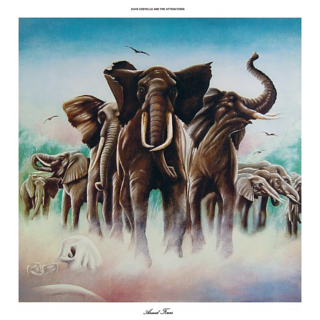
In those early days, "Armed Forces" was the album that stood out to me as Elvis' pinnacle. It was a pop kaleidoscope, an album that packed its brief running time with sticky melodies and shimmering performances from The Attractions. It was still awkward and literate, but with the costuming of being slick and professional to the nth degree. I preferred that to the rawness of "My Aim Is True", or the angry energy of "This Year's Model", because that was where my mind was at the time.
Over the years, my taste has changed, and so too has my attitude with regards to Elvis' music. My favorite Elvis albums are the ones that strip away the pretense of being anything but himself, the ones that are distilled to the basics of writing and recording. That elevates albums like "My Aim Is True" in my esteem, and puts "King Of America" on the highest of pedestals. It also means that "Armed Forces" is an album that began sinking before I started thinking more in depth about just how problematic the record is.
I went through the same experience with Weezer's "Pinkerton", where I was struck years after the fact by the toxicity and ugliness contained in the songs. "Armed Forces" is an album I always knew had at least one choice in extremely poor taste, but it really is more than that.
Keeping with the Weezer connection, we can start by reading into "Accidents Will Happen" an undercurrent of sexual misconduct. As the first verse tells us of a guy who "says he'll wait forever, but it's now or never", the titular 'accident' becomes the encounter she will soon grow to regret. Add onto that how "they say you're so young", and "they keep you hanging on until you're well hung", and the picture starts coming into focus of a pursuit that should not happen from either side. It is less an accident than it is a failure of the will. And to add insult to the injury, the song is a sloppy mess of writing, with Elvis switching from third to first person in the chorus, which invites more questions about what was happening in his personal life at the time to spark such a song.
"Oliver's Army" is the song that has had to explain and justify itself from the very beginning. Elvis' critique of English politics was slandered by his own choice of language, which is uncomfortable to print even for the purpose of discussion. Describing the scene at an armed checkpoint, Elvis uses the phrase "one more widow, one less white n----r", only to then say how "London is full of Arabs". It's a shocking comment, both because of the casual racism that is delivered without obvious irony, but also because it feels entirely modern. Those same complaints come out of the mouths of the most powerful people in the world today, and I'm not sure whether I'm uncomfortable about the language in the song, or that what was once problematic would probably slide by without a second thought if released right now.
We move on to "Big Boys", and the implications of using a woman for sex before discarding her, because that's what it takes "to be like the big boys". Perhaps Elvis' is innocent compared to the movie theater fellatio of Alanis Morissette's songwriting, but metaphorically calling the woman an 'ugly stick' only good for that purpose is not his finest hour.
Things get worse when we arrive at "Chemistry Class", where Elvis uses the lush arrangement and production to hide the 'pun' of the woman in his sights being in need of "the final solution". We could be charitable in reading this as a legitimate pun about chemistry, but given the language we already heard in "Oliver's Army", and that the next song is literally titled "Two Little Hitlers", the proliferation of racist and dehumanizing language feels like a difficult thing to extend grace over. Elvis then calls her garbage, literally, and implies she's so ill-equipped for the task that any experience she has was, yet again, purely accidental.
Which brings us to "Two Little Hitlers", which is the result of someone thinking they are far more clever than they really are. The song is a story of a dysfunctional relationship that results in her looking through the pages of a dating service for someone who could provide "some effective mating", which would be crude enough, but pales to the fact that Elvis somehow thought it was acceptable to compare this relationship to Hitler. I'm not sure there is any scenario in which that would be in good taste, but this certainly isn't it, especially after just using a term of genocide in regards to a woman in the previous song. No, this is thoroughly disgusting.
If one time is an accident, and two times is a coincidence, what does that make an album that consistently treats women as problems until and unless they are showing their physical affection? The very first line of Elvis' discography says, "now that your picture's in the paper being rhythmically admired", which I once thought was the most clever way of explaining that particular physical act, only to now realize that writing a song about jerking off to a woman's picture is creepy beyond words. Elvis was branded in those days as an 'angry young man' of rock and roll, but did anyone stop to ask what he was angry about? There were occasional bits of politics thrown in, but largely Elvis' anger was directed straight at women. The irony is he seemed as mad at the ones who did sleep with him as the ones who didn't.
I've learned a lot about myself and my own psychology over the years, and I'm rather proud to say I've never written a song with that kind of anger or toxicity in it. Despite these songs swimming in my head all this time, I have been able to avoid falling into the same ugliness. I can blame myself for my failings, I can see that I'm the problem.
So... do I not love "Armed Forces" the same way these days because I am no longer impressed by the ear candy covering the weaker writing, or do I not love "Armed Forces" because I now realize the damage loving such an album can do to me?
The answer is yes.

No comments:
Post a Comment